Mary Washington Physics Alum Wins Huge Award for Study of Tiny Particles
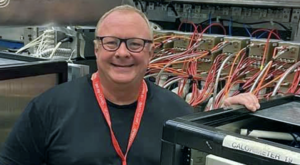
Painting a picture of the quantum realm has long been the mission of Brendan Casey ’92. His quest, which has spanned nearly two decades, won him and his colleagues the 2026 Breakthrough Prize in Fundamental Physics, one of the highest honors in the field.
“It’s real Antman kind of stuff,” said Casey, whose passion for physics research began as an undergraduate at Mary Washington. Now a senior scientist at Fermilab, a particle physics and accelerator laboratory in Illinois, he oversaw a team of 200 scientists who carried out the final phase of the experiment.
Unlike the Marvel movie, where characters shrink themselves to enter the quantum realm, Casey and his team made and measured muons – tiny particles that could change our understanding of the universe and the standard model of particle physics. The award they earned this spring places them alongside some of the world’s most renowned physicists, including Stephen Hawking, Jocelyn Bell Burnell and Kip Thorne.
“This is one of the greatest collaborations of all time,” Casey said. The research for the Muon g-2 experiment began nearly 60 years ago at CERN, a lab in Geneva, Switzerland; continued in Brookhaven, Long Island, in the 1990s; and eventually moved to Fermilab. All three facilities were recognized with the Breakthrough Prize for their contributions, sharing the $3 million prize that comes with the award.
