Undecided Voters Weigh in on Romney’s Convention Speech (PBS NewsHour)
The American Red Cross is sponsoring a blood drive at the Stafford campus on Tuesday, September 11 from 1 – 7 p.m. in University Hall. If you are interested in donating blood, please email Kevin Caffrey (kcaffrey@umw.edu) to make an appointment.
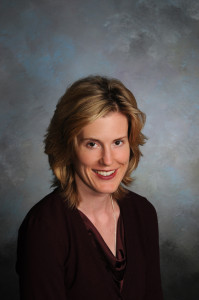
 Cate Brewer, visiting assistant professor of Theatre and Dance, directed a piece from Four Riffs for a Sailor by Monica Raymond with The Guillotine Theatre Company (formerly Georgetown Theatre), for The Kennedy Center’s 11th annual Page-to-Stage Festival this weekend. Four Riffs for a Sailor examines the roles of several female characters woven throughout Homer’s Odyssey.

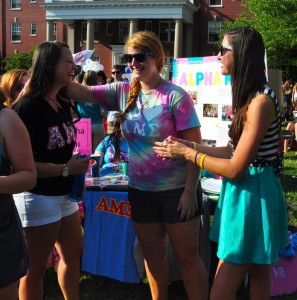
Hundreds of UMW students gathered on Ball Circle on Wednesday, Aug. 29 for the fall semester Club Carnival. Club Carnival is held at the beginning of the new semester as a way for students to get together and learn how they can get involved.
Leaders and members from each club braved the heat and sun to educate their peers about their group, showcase their clubs accomplishments and recruit new members.
With roughly 120 active clubs and organizations on campus there are plenty of options for students to volunteer with an issue they care about, further their studies, play sports or just meet with peers who have similar interests. A full list of the clubs offered at UMW, from biology and politics to Latin dancing and scuba diving, can be found at http://students.umw.edu/studentactivities/student-clubs-and-organizations/list-of-student-clubs/.
Local organizations such as the Rappahannock Emergency Services also attended the club fair to give students opportunities to get involved in their community outside of campus. Even some downtown Fredericksburg favorites like Sammy T’s made an appearance to give out free samples and coupons.

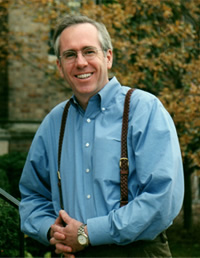
The Faculty and Alumni Convocation on Wednesday, Aug. 29 featured former Dean of the College of Arts and Letters at the University of Notre Dame Mark Roche’s keynote lecture about the role and position of the liberal arts. Roche, Reverend Edmund P Joyce, CSC Professor of German Language and Literature and Concurrent Professor of Philosophy at Notre Dame, is the author of seven books, including most recently “Why Choose the Liberal Arts?”
In his remarks, Roche argued for the intrinsic value of a liberal arts education, noting that the joy associated with exploring the life of the mind and the freedom to ask the great questions enshrine life with meaning. But he also stressed that the cultivation of these intellectual virtues are requisite for success beyond the academy. He made a compelling connection between the mental activity in which the liberal arts engage students and the development of character and a sense of vocation. Roche noted that recent surveys of employers indicate that they share this view. Recruiters value the outcomes of a liberal arts education: strong oral and written communication, critical thinking, connecting choices and actions to ethical thought, and an ability to innovate, he argued. Technical expertise by itself is outranked by all of these traits, he said.
Dean of the College of Arts and Sciences Richard Finkelstein also spoke about the importance of the liberal arts, addressing the changing, and often challenging, nature of the discipline:
“In the 19th-century, the essayist Matthew Arnold argued that the role of education is to impart ‘the best that has been thought and said.’ This is a view which most of us share, although with considerable caution. A century and a half later, I doubt many of us could agree on what those best thought and said ideas are; and I expect that some of us—and I include myself—recognize that in a world that recognizes the contingency of value, it’s doubtful that we can—or should—agree on what is ‘best.’ This is one of the reasons why we focus students on the methods and theories through which we acquire knowledge in our disciplines and not just on facts. Knowledge changes, and if there is a best knowledge it’s identified by the fact that it is always being amended. . . . Not knowing what the ‘best that has been thought and said’ is not relativism: it is, in fact, a crucial dogma for the liberal arts. Not knowing pushes us to develop new methods, push for challenging perspectives, and work across disciplines to create knowledge. It stimulates student interest with pedagogy that isn’t uni-directional.”