Author: Brynn Boyer

Nabil Al-Tikriti

Nabil Al-Tikriti, associate professor of history, gave a keynote address, “The State of Middle East Studies in the American Academy,” at the 5th Joint International Workshop held in Tokyo, Japan February 12-13.  Al-Tikrit also served as a discussant for the graduate student workshop “Science, Institutions, and Identity in the Muslim Societies” organized jointly by Kyoto University and the Tokyo University of Foreign Studies.


Doug Gately

Listen to “A Night of Jazz,” in The Underground. The program features a discussion led by Doug Gately, director of the UMW Jazz Ensemble, on jazz music in the African-American community and a performance by the UMW Faculty Jazz Sextet. 8 p.m. Free. 540/654-1044.

Revolution and Change in the Middle East

The University of Mary Washington invites the community to a panel discussion featuring UMW scholars of revolution, the Egyptian government, Islam, security and international relations. This event, “Revolution and Change in the Middle East,” will be held from 4:30 to 6 p.m. Wednesday, February 16 in Room 109 of Annex A, next to George Washington Hall.

The panel will include Jack Kramer, professor and chair of political science and international affairs and an expert on the study of revolution; Mehdi Aminrazavi, professor of philosophy and religion and an expert on Islam, politics and the Iranian revolution of 1979; and Ranjit Singh, associate professor of political science and international affairs, who will discuss the Egyptian government and its opposition. The moderator will be Jason Davidson, associate professor of political science and international affairs, who teaches security and international relations.

Admission is free. For more information, contact Ranjit Singh at rsingh@umw.edu or (540) 654-1496.

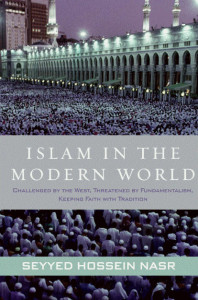
Islam in the Modern World, by Seyyed Hossein Nasr

Now in stock at the UMW Bookstore & faculty and staff receive 20% off.  The world’s fastest-growing religion is also the most misunderstood in the West.  In Islam in the Modern World, Seyyed Hossein Nars, on of the world’s leading experts on Islamic thought, explains why traditional Islam exists in tension with modern Western culture while at the same time it is also opposed by many currents of Islamic “fundamentalism.”  Nasr explains all the major points of tension–politics, philosophy, education, art, the role of women, and more–for how traditional Islam, rooted in the Qur’an and the sayings and actions of the Prophet Muhammad, differs from both modernism and Islam’s extremest factions.

“Nasr’s writing is lucid and conciliatory in spirit”      –Journal of the American Academy of Religion