
UMW Gives Credit to Digital World (The Free Lance-Star)
Alex Anderson ’15 breaks the national record at the NCAA Championships.
 Paul D. Fallon, Associate Professor of Linguistics, presented a paper at the 41st annual meeting of the North American Conference on Afroasiatic Linguistics (NACAL), held at Yale University on 16-17 February 2013. His paper, “Appleyard’s Proto-Agaw vis-à-vis Ehret’s Proto-Cushitic” compared the historical reconstruction of the Agaw (Central Cushitic) languages of Eritrea and Ethiopia by two different scholars, analyzing 200 proposed roots and categorizing them. The paper contributes to the the study of Agaw and Cushitic linguistics by providing a critical assessment of two reconstructions of the same language family.

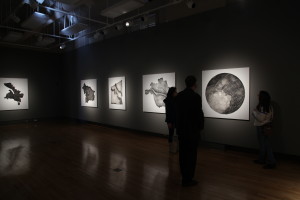
Rosemary Jesionowski, Assistant Professor of Studio Art, currently has a solo exhibition, Mapping Nowhere, on view at Randolph-Macon’s Flippo Gallery in Ashland, Virginia. This is her third solo exhibition in the past year. The body of work is a continual investigation of place, land, and how we identify ourselves through location. How do we define ourselves by where we live? How do others define us? How does place define or even change us? These images simultaneously reference a personal experience of place and an investigation of the relationship between people and place. The exhibition will be on view through April 5.

See more of Jesionowski’s work on her website.

Three articles previously published by Professor of Spanish Elizabeth Lewis on the late-Enlightenment dramatist María Rosa Gálvez were included in a new digital collection of the author’s life and work. The collection, edited by Helena Establier of the University of Alicante, Spain, is one of the newest additions to the Biblioteca Virtual Miguel de Cervantes, the most extensive collection of digital texts in Spanish. Two of the articles–”Breaking Chains: Language and Slavery in María Rosa Gálvez’s Zinda (1804).” Dieciocho. 20.2(Fall 1997) and “The Tearful Reunion of Divided Femininity in María Rosa Gálvez’s Neoclassic Theater.”Letras Peninsulares. 9.2(Fall 1996)—represent some of the earliest published studies on Gálvez. The third–“Crying Out for Feminine (Un)Happiness: María Rosa Gálvez’s Search For Sapphic Immortality”–was a chapter taken from Professor Lewis’s 2004 book Women Writers in the Spanish Enlightenment: The Pursuit of Happiness. Aldershot, Hants, England and Burlington, Vt.: Ashgate Publishers.