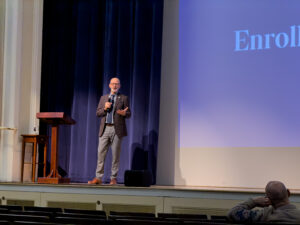
University of Mary Washington President Troy Paino speaks at the spring 2026 all faculty and staff assembly
The University of Mary Washington’s spring 2026 all faculty and staff assembly started off the semester with an end goal in mind, and the goal of UMW’s 115th Commencement in May. Yet, there are plenty of projects and plans in place before then and beyond, as UMW President Troy Paino shared updates with campus on the strategic action planning process, enterprise resource planning, and the evolution and revolution of artificial intelligence.
“When you’re thinking about the next five or six years of Mary Washington … ask yourself whether or not we are doing enough to … offer an education that appeals to students as relevant to their lives, that can help them now, into the future and throughout their lives.”
He announced “MaryWashAI,” an enterprise AI platform, now in the pilot phase with several early adopters through faculty and staff, in partnership with Information Technologies and the Center for AI and the Liberal Arts. He also noted the importance of accessibility improvements, ongoing from the fall, in progress to meet state and federal requirements in April.
Turning to campus construction, Paino commended the work of Facilities Services, pointing to the completion of Seacobeck Hall roof work, along with the stairwell and façade in Simpson Library, which will also undergo a feasibility study to inform further renovations. In addition, Ball Hall is being revamped with an eye toward improving accessibility and welcoming students this fall, and roof work is planned in George Washington Hall.
Also, he said, spaces are being cleared – including tree removal and the beginning of demolition of Marshall and Russell halls – to make way for the new academic home to UMW’s Department of Theatre and Dance, with construction of the new theatre slated to start later this year. And new locker rooms being installed at the Battlefield Athletic Complex should be ready by fall.
It’s one of many campus projects that will benefit students. Paino also noted many ways that UMW continues to be a leader in undergraduate liberal arts education. “We know we operate in an incredibly competitive environment,” he said, “but we continue to hold our own in this marketplace.”
In that vein, Paino highlighted the importance to families of financial aid, which is already rolling out to admitted students and the upcoming Feb. 1 deadline for priority admission. “It is each and every one of our responsibility to recruit students …,” he said. “What seals the deal is their experience when they come onto campus.”
Campus safety continues to be a top priority, with additional investments made in building systems and blue lights across campus. With state funding, UMW is beginning the process to transition to a new university-wide resource management planning system, with additional funding a legislative priority this session.
In addition, UMW’s new Master of Science in Nursing (MSN) has been approved. With nurse practitioner and nurse educator tracks, it aims to address workforce shortages in the area and continue Mary Washington’s long-term regional work in education. Reminding the crowd that Mary Washington was established as a teachers’ school in 1908 to meet a critical need, Paino pointed to the University’s responsibility to meet today’s critical needs in healthcare. The nursing programs are just part of that pipeline, as additional partnerships and programs are being explored, including a community-based medical school.
With key dates on the horizon, including the 100th anniversary of Devil-Goat Day, ASPIRE Week and Mary Wash Day, Paino urged UMW faculty and staff to be pro-active and bold.
“This is not a time to be shy, timid or reserved,” he said. “We really need to think boldly about how we can be leaders in our space as a public liberal arts and sciences university in the age of artificial intelligence and other things we have to deal with in the marketplace.”
Mary Washington employees, he said, should focus on the University’s mission, the work ahead and a collective responsibility to students.
“We have roughly 4,000 students here under our charge. Every day the work that we do makes a difference in their lives. That in and of itself should give us hope for the future, despite the times we’re living in,” he said. “Think about the possibilities for the future, what Mary Washington can become and the public good that we can serve.”