
Professor of Middle East History Nabil Al-Tikriti presented a paper last month entitled “The John Elphinstone Papers and the 1770 Battle of Çeşme” to the 7th International Conference of the Mediterranean Maritime History Network, in Zadar, Croatia. This conference hosted approximately 30 papers covering topics as wide-ranging as 19th century smuggling, maritime conflict, archival documents in Croatia, and many others. In the course of this conference, Al-Tikriti discovered the existence of a surprising number of Ottoman documents held regionally, discussed Fulbright possibilities with colleagues in attendance, and explored publication potential of this project originally driven by UMW student research. Al-Tikriti was grateful to the conference organizers for this outstanding scholarly exchange.
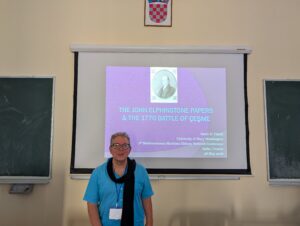
The paper abstract was as follows:
“In July 1770, the Russian Baltic Sea fleet defeated an Ottoman fleet in the Aegean Sea between the coast of Çeşme and the island of Chios. The Russian maritime intervention was supported by Greek fighters who might be classified as proto-nationalist leaders, and was partially commanded by an English mercenary named John Elphinstone. The Ottoman side, meanwhile, was commanded by an eccentric Georgian admiral named Cezayırlı Hasan Paşa who won some fame for his love of domesticated lions.
This battle took place as part of the 1768-1774 Russo-Ottoman war, a decisive Russian victory which transferred parts of the Northern Caucasus, Crimea, and Southern Ukraine from Ottoman to Romanov control. The war ended with the 1774 Treaty of Küçük Kaynarca, which scholars have long considered a turning point in Ottoman diplomatic history, largely because the two signatory empires traded protector status, with the Russians claiming that status over Ottoman Orthodox Christians and the Ottomans claiming the same status over Russia’s Muslim populations.
In my presentation, I intend to examine the role that Captain John Elphinstone played in these events by summarizing and analyzing his memoirs and related documents. His papers provide an eyewitness perspective of the diplomatic, military, and political intrigues surrounding the war in general, and the Battle of Çeşme in particular. More broadly, I intend to explore some of the larger legacies of this war on Russian-Ottoman relations, the progressive expansion of Russian sovereignty southwards in the 18th-19th centuries, the emergence of an independent Greece, and the contemporary relevance of these events to the international relations of Eastern Europe and the Black Sea region. This presentation is part of my broader research agenda to assemble a scholarly analysis of his memoirs and what they tell us about his role in the 1770 Russian expedition.”
In addition, Al-Tikriti was interviewed last month by Gulan Media on regional affairs. In this wide-ranging interview, Al-Tikriti discussed the historical basis of regional sectarian conflict, Middle Eastern developments related to the current US-Israel-Iran conflict, longer term legacies in Iraqi politics of the 2003 Anglo-American invasion, and potential future effects of the current conflict with Iran on the U.S. and global economies. Lean more in the full interview from Gulan Media.