Stop by the Bookstore and purchase a UMW holiday t-shirt* … Perfect for yourself, family and friends!

* While supplies last
Happy Holidays,
UMW Bookstore
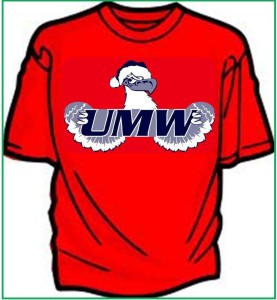
Stop by the Bookstore and purchase a UMW holiday t-shirt* … Perfect for yourself, family and friends!
* While supplies last
Happy Holidays,
UMW Bookstore
Since August, UMW faculty members have received more than $350,000 in external grant funding.
Patricia Reynolds, assistant professor in the College of Education, received $174,787.20 from the Virginia Department of Education to deliver graduate level courses in differentiated instruction across the curriculum for English language learners. The grant provides tuition support for teachers who enroll in the courses, covers the costs of textbooks, and also covers all costs related to offering the classes at two off-campus locations (in Norfolk and Stafford County). The award covers both the fall and spring semester offerings of the course in 2012-2013. This is now nine times that UMW has received a grant from the VDOE to provide the differentiated instruction courses.
David Toth, assistant professor of computer science, has received two awards from XSEDE, an online distributed virtual organization. Toth is collaborating with faculty at Merrimack College on two separate projects: “Identifying Inhibitors that Prevent the Complexation of HIV-1 Tat•P-TEFb thus Blocking HIV Replication” and “Identifying Inhibitors of the Fungal Virulence Factor Cbp1.” The projected value of the computing time for the first project is $34,500, and the value for the second project is $114,278.
Norah Hooper, professor in the College of Education, received $30,858 from the Virginia Department of Education to develop a “Traineeship for Education of Special Education Personnel for Regions 3 and 4.” This is the third such grant award for her. The grant provides support for a minimum of 12 teachers who hold provisional licenses in Special Education: General Curriculum to complete all or part of the coursework and field experiences required for full licensure. Participants will receive tuition support and will be connected with fully licensed mentors in their schools. The mentors will receive stipends and training in effective mentoring techniques.
Lynn Lewis, professor of biology, is supervising her student Ryan Green’s research on “A Study of Chloroquine’s Antiretroviral Characteristics.” The Virginia Academy of Science made a $500 award in support of this undergraduate research project.
For more information on external grant activity this semester, read the most recent issue of the provost’s newsletter.
 John P. Broome, assistant professor in curriculum & instruction and director of secondary education and preK-12 education in the College of Education, was spotlighted in the latest edition of Keying In, a publication of the National Business Education Association (NBEA). This publication showcased how and why professors from around the country used the “flipped classroom” (or reverse teaching) model in their instruction.
For Broome, the answer was more than incorporating engaging technology. It was to address his enabling of students to not complete their course readings. In his opinion, the more educators summarize readings (instead of clarify), fewer students read and more fake and “do college.”
Excerpt from the article:
“John Broome flipped his classroom to solve a problem. But Broome’s issue was ideology, not logistics—class time was consumed with summarizing course readings. This left little time for content application, but more importantly, few opportunities for guiding students’ critical thinking abilities. He felt his courses were missing their potential.
‘Those who do the work do the learning. Summarizing content for them takes the thinking away from them,’ he says. ‘Too many educators might be enabling this.’
Broome compiled a list of resources students could use to prep for class: readings and videos from education associations, professional learning communities, and other universities. Before class, students took online quizzes to assess what they’d learned.
Class time was freed up for applying new knowledge while Broome provided guidance, initiated reflective discussions, and aided students. The less he talked, the more he got to know his students and the more he was able to provide personalized instruction and feedback. ‘My students were very receptive to more individual attention and help with activities,’ he says. ‘It made my classes more personable and productive.’
And because Broome refused to enable students, they began taking more responsibility for content and more risks with it, in a safe learning environment.
‘Not all students learn best at the same time. [By flipping the classroom] learning new content isn’t constrained to an artificial class time,’ he says. ‘Students can approach learning when their brains are available to process new information. It provides them with ownership of learning when [the time] is best for them.’
This year Broome received a grant from his university to begin making his own videos and other digital resources. ‘This takes a lot of time and dedication,’ he says, ‘but this way my students get the most out of my courses.’”
Dr. Broome is currently in the second UMW Online Learning Initiative cohort and learning new software and skills to continue to “flip” his education courses.
 Bob Greene and Margaret Mi of the College of Business wrote a manuscript, “Systems Model for Teaching the Human Resource Management Process,” which was accepted for presentation at the Society of Business Research conference in Nashville, Tenn. Margaret Mi presented the paper which will appear in the conference proceedings. The manuscript has been submitted to the Journal of Human Resource Education for publication.
 Yuan-Jen Chiang, professor of mathematics, has a research article “f-biharmonic Maps between Riemannian Manifolds” published in the Journal of Geometry and Symmetry in Physics. The article was presented at the 14th International Conference in Geometry, Integrability and Quantization organized by the Bulgarian Academy of Sciences in Varna.