Belmont, the historic home of artist Gari Melchers and his wife, Corinne, will celebrate the season, with decorations on view Nov. 25 through Dec. 30. In the 1920s, the Melchers took great delight in festively decorating their elegant country house during the holidays. Although Gari Melchers divided his time between his commercial headquarters in New York […]
Eagle Eye View
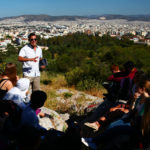
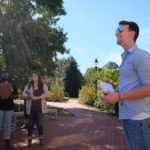
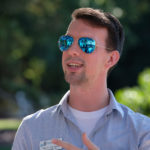
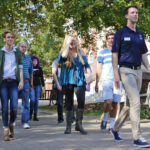
Welcome to your UMW campus tour with senior guide Marc Gehlsen.
11:30 a.m., Lee Hall: Home of Admissions, Student Services, Financial Aid and More
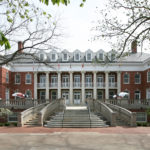
You push open the door to Lee Hall, step out onto the sun-soaked stone terrace. Blinded, you squeeze your eyes shut, replay the admissions message inside your head. You refocus, look out onto the Fredericksburg campus. In a flash, you see your future unfold.
11:32 a.m., Ball Circle: The center of Mary Wash student life and traditions
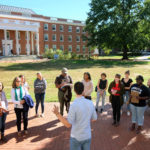
You hurry down the steps to join your tour group. That’s when Marc Gehlsen whisks onto the scene.
He struts like a drum major across a faux stage. Anything to get your attention. “A big word on campus is ‘tradition,’ ” he says, pointing to the spherical lawn, site of uniquely Mary Washington customs like Club Carnival and Devil-Goat Day. He reveals he’s a devil, spars with a mom in the crowd who says she’s a goat.
A Washington Guide, Gehlsen has led UMW tours for years, zany one-liners, colorful commentary and all. He delivers in English, of course, but he also speaks Spanish, French, Chinese, Russian and Arabic. His love of language will take him into the courtroom as a forensic linguist, but for now he’s using his words to wow campus visitors – like you.
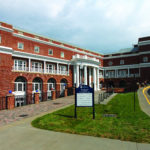
11:37 a.m., Randolph-Mason Hall: One of Mary Washington’s 18 residence halls
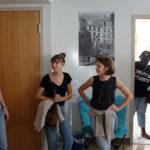
You stroll along Campus Walk toward Randolph-Mason Hall, dodging a squirrel on the way. Inside, Gehlsen starts in – student IDs, laundry, bathrooms. Private or shared, he jokes, they both accommodate the urge to “sing Disney ballads in the shower.”
He had his share of sharing growing up, the youngest of five on a Nokesville, Virginia, Christmas-tree farm. He gleaned what he could from his siblings, who all studied language before him, and from the migrant workers his father, a masonry carpenter, invited to dinner.
By the time Gehlsen took Spanish in middle school, he could curl and roll r’s like nobody’s business, and he zoomed to the top of his class. Other languages followed, including Hawaiian, because “who doesn’t want to say ‘aloha’ whenever they get the chance?”
In college, Gehlsen knew he would major in Spanish. A campus tour led him to choose Mary Washington. It was fall, and the scenery and sense of community – everyone seemed to smile and say “hi” – cast a spell, he said, like a wand that finds the right wizard. Hands all aflutter, he demonstrates the Harry Potter effect for your tour.
11:45 a.m., Palmieri Plaza: A signature UMW meeting area, complete with fountain
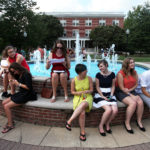
You move on with the group, trailing Gehlsen up the hill to Palmieri Plaza. “You have to swim in the fountain at least once before you graduate,” he says. “If you’d like to try it before the end of the tour, you’re welcome to.”
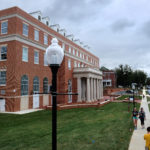
11:47 a.m., Monroe Hall: One of UMW’s many academic buildings, housing history, geography and political science
Lost in the bubbly blue water, you realize the crew has moved on without you. You catch up, climb the steps to Monroe Hall. File into a classroom. Slide into a desk. Gehlsen’s up front, explaining UMW’s Honor Code, Office of Disability Resources and opportunity to create unique courses of study. He dishes on his own second major, a linguistics program he crafted himself.
“His brain has a knack for language,” said Betsy Lewis, professor of Spanish and chair of the Department of Modern Languages and Literatures. “Some students worry they’ll make a mistake. They freeze up. Marc’s personality is so outgoing he can just jump right in and not worry about any of that.”
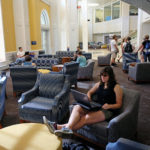
A Phi Sigma Iota language honor society member, he studied abroad on a trip Lewis led to trace Don Quixote’s footsteps through Spain and plans to pursue a master’s degree in linguistics on the West Coast. At UMW, Gehlsen has handled social media for the Honor Council, coordinated programming for Green Housing, and started an honors thesis that keeps him holed up in the Hurley Convergence Center. Your group heads there next.
11:56 a.m., Hurley Convergence Center: Four stories of state-of-the-art tech capabilities
You walk on, passing Simpson Library and Blackstone Coffee, which a fully caffeinated Gehlsen calls “the most important building on campus.” You visit the Goolrick Hall gym, see the Anderson and University centers, before returning to Lee, where you browse through the bookstore for the perfect memento.
But you know you’ll be back.
It’s a quick glimpse of campus, but for Gehlsen – who caught the tour-guide bug as a freshman, brewing coffee and propping open the door of his Randolph Hall room, which was part of the rounds – it speaks volumes.
“I’ve loved every single second of it,” he said. “I get to spread the word of the UMW awesomeness.”
Intrigued by Gehlsen’s tour of the UMW campus? Want to see more? Take our guided, interactive virtual tour!
A Trick-or-Treat Tradition
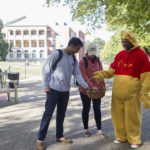
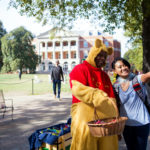
Sinister fairies, evil Jedis and monsters crept onto Campus Walk on Halloween morning, all with one thing in common. No one could resist the chubby, honey-loving bear offering candy and hugs.
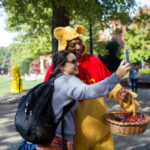
One day a year Associate Vice President and Dean of Student Life Cedric Rucker ’81 sheds his signature bow tie and seersucker pants to become the iconic Winnie the Pooh. It’s not just a costume for Rucker. He sees it as part of his job – spreading friendship, community and care – for the past 15 years.
“Pooh and Dean Rucker are just two very happy, jolly people,” said senior Mikey Barnes. “Walking down Campus Walk and seeing this prominent figure dressed up as Winnie the Pooh … I look forward to it every year.”
In 1977, when Rucker was a Mary Wash freshman, “Halloweens” was a giant affair, with revelers from schools near and far making their way onto campus. They came as M&Ms, policemen and the complete cast of Star Wars, Rucker remembered. And with the release of the feature film Animal House the following year, “I cannot tell you the amount of togas people wore,” he said.
After earning a master’s degree in sociology from the University of Virginia, Rucker returned to his alma mater to serve as associate dean of student activities. He’d been promoted to dean of student life by the time he saw Andrew Painter ’02 crashing the Fredericksburg Christmas parade, bounding down Caroline Street as Tigger.
The Disney-esque costume planted a seed for Rucker, who tracked down a matching Pooh suit. Its fuzzy exterior and built-in mittens are a great fit for fall. The cut-out up top shows Rucker’s face and big smile.
Painter was surprised to learn recently that he’d inspired the long-running tradition, but he wasn’t shocked to hear that Rucker’s still at it. “Cedric cares genuinely for Mary Washington. He cares genuinely for the students,” Painter said. “He loves to bring happiness to everyone.”
The ensemble accommodates the serious side of Rucker’s job, too. He can jump in and out of it to advocate for students, meet with administrators and teach his Monday night sociology class.
In costume, he strolls Campus Walk, spending time at Lee Hall and the University Center, where students stream by between classes. Fresh off of midterms, they stop for selfies with Pooh, candy, hugs and one other thing – words of wisdom.
“Pooh reinforces the values we have as a community,” Rucker said, “respect, student engagement, empowering students to support one another.”
The warmth goes both ways.
Last year, when his mother passed away two days before Halloween, Rucker pushed through his grief to make his annual appearance as Pooh. He announced it on Facebook, and students showed up in throngs.
“The outpouring was incredible,” he said. “I love these people.”
Front-Row Seat
UMW sophomore Mackenzie Hard’s iPhone slices into her sleep.
4:30 a.m.: “Good morning, crazy kid!”
She stirs at the first pre-programmed message, settles back in under the extra-long quilt her grandmother made for her 6-foot-2 frame.
4:45 a.m.: “If you don’t get up now, you won’t see the sun rise!”
She opens an eye, feels her FOMO kick in. But her Eagle Village room is … so … comfy.
5 A.M: “Okay, now you’ll really be late, way to go.”
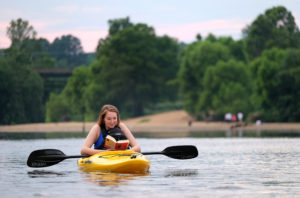
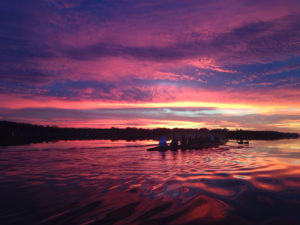
The tone serves its purpose. She’s up. In a race with the sun. Off to meet crewmates at Alvey parking garage at 5:30, be out on the water by 6.
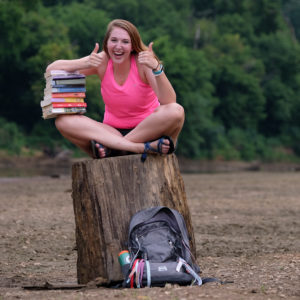
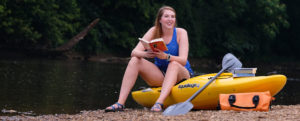
Growing up in Colonial Williamsburg and on Jamestown Island, Hard was as absorbed in water as she was in history. UMW would revive her passion for both. Now a crew member and English major pursuing a master’s degree in education, she hopes to teach high school, helping steer students toward their own college adventures.
“It was such a tough and busy time of my life,” Hard said of that 12th-grade transition. “I want to be able to tell them, ‘I know what you’re going through. I know it’s hard. You’ll get through it. Let me help you.’ ”
When she wasn’t playing the snare in the Colonial Williamsburg Fifes and Drums Corps or learning open-hearth cooking as a young volunteer, she’d spend long summer days on the James River. Then the air would turn crisp, and she’d go with her mother, a teacher, to help prep her second-grade classroom. Hard would play with the old-fashioned projector and sometimes, just sometimes, pretend to be a teacher, herself.
In high school, instructors she touts as “flawless” inspired her further, fueling her love of English. A fan of Harry Potter and The Hunger Games, Hard played basketball and edited the yearbook before turning her thoughts to college. The first time she saw “UMW” on a T-shirt, she Googled it. She liked what she saw and scheduled not one but five visits to campus.
“I love our community. I love that we’re small,” she said during an interview at the Hurley Convergence Center. “I love that I have friends who walk in here and I can wave at them while we’re doing this.”
She was just meeting some of those friends when she showed up at that first Club Carnival freshman year, set to play basketball. Instead, she was coaxed into crew, where she found an unexpected camaraderie.
“The rowers tend to develop some pretty close relationships,” said Rich Adams, who coaches the team. “It requires a lot of discipline. The people that are not so tough very quickly decide it’s not the sport for them.”
But Hard has a soft side, as well. She cried last December to miss Williamsburg’s Grand Illumination, watching it live-streamed, instead, while she studied for finals. But her on-campus commitments leave little time to be homesick. She’s a resident assistant and Washington Guide who’s involved with Best Buddies. And, of course, there’s crew.
“The power and muscle and strength of eight girls in a boat?” she said. “It blows me away.”
Ready for Rio
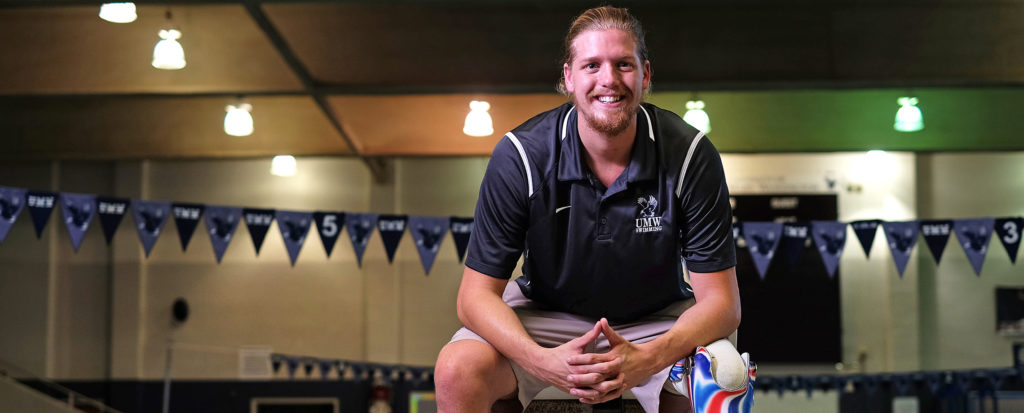
Beaming in a photo in front of Big Ben, Dalton Herendeen couldn’t have known he’d leave London, and the 2012 Paralympic Games, without gold, silver, or bronze. Or that he would have a second shot next week in Rio de Janeiro, Brazil.
“I will have a chance to medal,” said Herendeen, UMW’s assistant swim coach. “That’s the thing that drives me the most now.”
Born with a blood clot that caused the loss of his lower left leg, Herendeen plunged into sports anyway, finding his niche in the pool. A record-breaking opponent to able-bodied swimmers, he would question his fit in the Paralympics. But in the long line of coaches he’d learn from, one would push him to try. Another would make sure he got there again.
“A medal would be amazing,” said Eagles head swim coach Abby Brethauer, who hired Herendeen and spent the past year training him for Rio. “I just want him to be happy with the way this journey ends.”

But first, the beginning.
Growing up in the Midwest, Herendeen tackled a series of clunky prosthetics but played the same sports as his siblings – basketball, football, and soccer. In the water, he excelled. Despite his disability, he’d made the state finals in high school and earned a scholarship to the University of Indiana. So when his coach suggested he look into the Paralympics, Herendeen balked. Competing against handicapped swimmers seemed like a step backward.
But he came around.
“I thought I was going to destroy these kids,” said Herendeen, who was disarmed by the wheelchairs and prosthetics that scattered the deck at that first 2008 meet. “But they were phenomenal. I got my butt kicked.”
He licked his wounds and set his sights on 2012. For the next four years, he would eat, sleep, and breathe swimming, and it paid off. But despite his sturdy performance in London, there would be no medals to bring home.
Distraught, Herendeen no longer wanted to look at a pool much less swim in one. That’s when he got a call from the folks at Bates College Swim Camp, which UMW’s Brethauer co-founded. They had seen a feature on him in the NCAA magazine Champion and asked him to join their coaching team.
Working with kids turned things around, pumped Herendeen up, and pulled him back to the pool. Back at U-Indy, he broke lots of records and became captain of the school’s Division II team. When he graduated, Brethauer asked him to coach at Mary Washington and promised to train him for Rio.
Then, at last year’s world championships in Scotland, something went wrong. Herendeen blew out his right knee, the good one, and had to have surgery. With Brethauer’s encouragement, he pressed through the pain of recovery and continued to train.
The two would spend hours each day in the Goolrick Hall pool or in the long-course lanes at the Jeff Rouse Family Swim and Sport Center, where Herendeen coaches the Fredericksburg Stingrays. Together, they’d focus on the technique and strategy he would need in Brazil, where he’s slated to compete in the 400-meter freestyle, 200-meter individual medley, 100-meter butterfly, 100-meter breaststroke and 400-meter medley relay.
Four years ago, at the Paralympic Games in London, Herendeen said, he was star struck. Just getting there was enough, and he soaked it all in. This time around he wants more.
“I’ve accomplished everything I want to in my career; the only thing I have not done is to medal,” he said. “Whether I do or I don’t, what I want to be able to do … is say, ‘Dalton, you gave it everything you had.’ “
The 2016 Paralympic Games run Sept. 7 to 18. Find the schedule online at https://www.rio2016.com/en/paralympics/schedule-and-results.
Ready for Rio
Beaming in a photo in front of Big Ben, Dalton Herendeen couldn’t have known he’d leave London, and the 2012 Paralympic Games, without gold, silver, or bronze. Or that he would have a second shot next week in Rio de Janeiro, Brazil.
“I will have a chance to medal,” said Herendeen, UMW’s assistant swim coach. “That’s the thing that drives me the most now.”
Born with a blood clot that caused the loss of his lower left leg, Herendeen plunged into sports anyway, finding his niche in the pool. A record-breaking opponent to able-bodied swimmers, he would question his fit in the Paralympics. But in the long line of coaches he’d learn from, one would push him to try. Another would make sure he got there again.
“A medal would be amazing,” said Eagles head swim coach Abby Brethauer, who hired Herendeen and spent the past year training him for Rio. “I just want him to be happy with the way this journey ends.”

But first, the beginning.
Growing up in the Midwest, Herendeen tackled a series of clunky prosthetics but played the same sports as his siblings – basketball, football, and soccer. In the water, he excelled. Despite his disability, he’d made the state finals in high school and earned a scholarship to the University of Indiana. So when his coach suggested he look into the Paralympics, Herendeen balked. Competing against handicapped swimmers seemed like a step backward.
But he came around.
“I thought I was going to destroy these kids,” said Herendeen, who was disarmed by the wheelchairs and prosthetics that scattered the deck at that first 2008 meet. “But they were phenomenal. I got my butt kicked.”
He licked his wounds and set his sights on 2012. For the next four years, he would eat, sleep, and breathe swimming, and it paid off. But despite his sturdy performance in London, there would be no medals to bring home.
Distraught, Herendeen no longer wanted to look at a pool much less swim in one. That’s when he got a call from the folks at Bates College Swim Camp, which UMW’s Brethauer co-founded. They had seen a feature on him in the NCAA magazine Champion and asked him to join their coaching team.
Working with kids turned things around, pumped Herendeen up, and pulled him back to the pool. Back at U-Indy, he broke lots of records and became captain of the school’s Division II team. When he graduated, Brethauer asked him to coach at Mary Washington and promised to train him for Rio.
Then, at last year’s world championships in Scotland, something went wrong. Herendeen blew out his right knee, the good one, and had to have surgery. With Brethauer’s encouragement, he pressed through the pain of recovery and continued to train.
The two would spend hours each day in the Goolrick Hall pool or in the long-course lanes at the Jeff Rouse Family Swim and Sport Center, where Herendeen coaches the Fredericksburg Stingrays. Together, they’d focus on the technique and strategy he would need in Brazil, where he’s slated to compete in the 400-meter freestyle, 200-meter individual medley, 100-meter butterfly, 100-meter breaststroke and 400-meter medley relay.
Four years ago, at the Paralympic Games in London, Herendeen said, he was star struck. Just getting there was enough, and he soaked it all in. This time around he wants more.
“I’ve accomplished everything I want to in my career; the only thing I have not done is to medal,” he said. “Whether I do or I don’t, what I want to be able to do … is say, ‘Dalton, you gave it everything you had.’ “
The 2016 Paralympic Games run Sept. 7 to 18. Find the schedule online at https://www.rio2016.com/en/paralympics/schedule-and-results.
Back to the Future
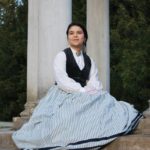
Laura Gilchrist’s sense of style unfolds on Facebook, where the UMW senior sports an Eagles sweatshirt and jeans, a leather jacket and shades, a black and white dress with heels.
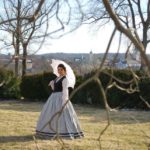
But this 21st-century student feels just as tres chic when she pulls on a corset and a pair of starched stockings.
“All of a sudden you walk a little straighter,” said Gilchrist, who’s donned period garb and done historic re-enacting for years. “You’re a whole different person. It transports you to another time.”
She hopes her dream job as a museum curator will, too, pushing her into the past and feeding her passion for sharing it. A hotshot in UMW’s prestigious historic preservation program, she’s as dynamic as the degree she is working to earn.
“Laura is simply outstanding,” said Assistant Dean for Student Involvement Melissa Jones. “She’s taken her Mary Washington experience and capitalized on every bit of it.”
Commuter Student Association president, Class Council vice president, student orientation coordinator, historic preservation student aide and Washington Guide, Gilchrist blazes like wildfire through the campus she loved at first sight. A postcard memento from that middle school visit a decade ago still graces her desk.
Born in Panama, Gilchrist was nudged by her aunt, a Central American Supreme Court justice, toward a career in the law. But when her military family moved to Dahlgren, Virginia – and the historic Fredericksburg area – she found something new … and something old.
They joined the Rappahannock Colonial Heritage Society, where Gilchrist delved into 18th-century drama and dance. As her love of heirlooms and relics took on a life of its own, so did her wardrobe, brimming with petticoats and parasols, bloomers and ball gowns.
Then, in high school, a second jaunt down Double Drive – this one for Discovery Day –showed Gilchrist how her love of the past could help shape her future. She sat in on a historic preservation class, talked in depth with former department chair Gary Stanton and made a decision.
“I love history. I love historic re-enactments. I didn’t know you could do something with that,” said Gilchrist, who set her sights on UMW’s historic preservation program, one of the best of its kind in the country. “This is exactly what I want to do with my life.”
Now, as she nears graduation, she’s working to wrestle her resume onto one page. She’s helped refurbish the Frank Lloyd Wright House, attended Colonial Williamsburg conferences, spent Spring Break at the Craik-Patton House. And that’s just for starters.
“We don’t watch PowerPoints,” Gilchrist said of UMW’s unique and highly hands-on program. “We learn by touching and holding, so you can actually understand.”
Winner of Mary Washington’s Bowley and Annie Fleming scholarships, she’s planned exhibits and led lessons at famous Fredericksburg sites like James Monroe Museum, Kenmore Plantation and Mary Washington House. Online, she blogs about English Regency-era styles.
And on campus? Gilchrist will welcome her brother, Michael, to UMW’s Class of 2020 in August and finish her own degree in December. But she plans to stick around for one more semester to wrap up her responsibilities with Class Council and more.
“Once I’m going, you can’t stop me,” she said. “I put myself into everything I do. I feel that’s the only way to live life.”
Quantum Leap
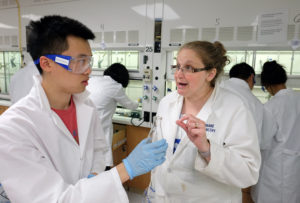
Benjamin Nguyen tugged at his blue-rimmed goggles and held his breath, a test tube teetering in his hand. A standout student from Valencia High School in Orange County, California, he knows his way around a lab, but after shattering a pair of beakers the day before, he wasn’t taking any chances.
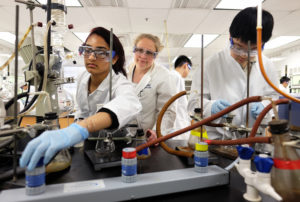
Nguyen was among 20 teenage chemists, top scorers from across the country, to converge on the University of Mary Washington’s Jepson Science Center early this month. Professor of Chemistry Kelli Slunt, long involved with the U.S. National Chemistry Olympiad, pushed for UMW to host its annual two-week summer training camp, held until this year at the U.S. Air Force Academy (USAFA) in Colorado.
“This is huge,” said Slunt, 2016 head camp mentor. “For my colleagues and me, it’s an opportunity to teach and mentor students of the highest academic caliber, future leaders in the scientific community. For UMW, it’s an opportunity to showcase our excellent facilities and dedication to STEM.”
Plucked from high schools in 10 states, from New York to Texas, star chemistry students – seven girls and 13 boys – rose from the ranks, outscoring more than 1,000 peers who sat for the nearly five-hour national exam. Four finalists will go on to represent the United States at next month’s 48th International Chemistry Olympiad in Tbilisi, Georgia.
The summer camp, sponsored by the American Chemistry Society, is loaded with labs, lectures, and exams covering analytical, organic, inorganic, physical, and biological chemistry.
“It’s a very intense program,” said Jacob Sanders, a camp peer mentor and Harvard doctoral student who won silver at the 2005 international competition in Taipei, Taiwan. “They’re basically learning about chemistry and thinking about chemistry every day for two weeks.”
Due to concerns over which country would host this year’s final contest, camp organizers were too late to reserve space, as they normally do, at the USAFA. When UMW came up as an alternate venue, Slunt slammed into high gear, consulting with colleagues, lining up logistics, and pushing fellow faculty members into new territory.
“I’m going to try and not let America down today,” Associate Professor Nicole Crowder joked at the start of a Friday morning lecture on cubic structures.
UMW Assistant Professor Davis Oldham and Associate Professor Charlie Sharpless took turns teaching classes, along with Associate Professor Leanna Giancarlo, who also served as camp coordinator. Fredericksburg-area retired chemist William Wacher and a handful of Mary Washington students pitched in, as well, helping prepare solutions and samples for the chemistry-savvy contenders.
Sending its first team to the global competition in 1984, the U.S. has twice won the International Chemistry Olympiad.
Slunt, who earned a bachelor’s degree from UMW in 1991 and a Ph.D. in chemistry from U.Va. in 1995, also directs Mary Washington’s Honors Program. She fit the organization and orchestration of the camp into her already-crammed schedule, working to squeeze it in between a European Capitals study-abroad trip and her own 25th UMW reunion.
For what the experience gives budding young chemists across the United States, though, she’d do it all again. “It was an honor to be asked to host this event at UMW.”
Long-Term Goals
UMW senior Haley Kane crossed the stage in the standard black cap and gown. What the crowd at Commencement couldn’t see was the brilliance beneath, from her hot pink Lilly Pulitzer dress with the shimmery trim to the goldmine of honors she collected in college.

“I hold myself to really high standards,” she said. “I wanted to fully experience what a liberal arts school could offer. I wanted to take hold of everything, and I think I did a pretty good job.”
Her sentiment might be the understatement of the semester. In fact, when Haley turned her tassel, she became one of Mary Washington’s most recognized graduates, both academically and athletically. Ever.

A psychology major with a perfect 4.0 GPA, she led UMW’s Division III field hockey team through four stellar seasons, three of them as captain. She’s twice been named scholar-athlete of the year by both UMW and the National Field Hockey Coaches Association (NFHCA). To top it all off, just before accepting her diploma, she learned that she’d also won the University’s prestigious Colgate W. Darden Jr. Award, given to the senior with the highest grade point average.
“Haley has left an indelible mark at the University of Mary Washington,” said Director of Athletics Ken Tyler. “Her accomplishments speak for themselves, but what’s even more impressive are the years of hard work and dedication that made them possible.”
As those years progressed, so did her resolve to give 100 percent, no matter what.
Growing up on a quiet Henrico, Virginia, cul-de-sac, she rode bikes with the neighbors, played soccer and danced. But as the summer of 2001 ground to a halt, so did her childhood. Her father, a civil engineer with chronic kidney disease, died suddenly that August while playing softball. Haley was 7.
Her mother, Irene Sterne Kane ’85, packed up the family, including Haley’s twin brother and younger sister, and moved back to her hometown of Fredericksburg, where Haley found solace in field hockey.
“Nothing bothered me when I was on that field – either practicing or playing,” she said. “It was a wave of pure happiness.”
She played varsity through high school. But while she worked her midfield position, tracking offense and defense, pressure and pain filled up her legs, her feet would go numb. Doctors thought it was shin splints, but physical therapy – years of it – did nothing to help.
“It was pretty painful, but I’m the kind of person who just pushes through,” Haley said.
Finally, she was diagnosed with compartment syndrome, which keeps tissue from stretching enough to accommodate the muscle inside. The cure, at least for Haley, was an inpatient surgery and physical therapy. But while the condition had kept her from trusting her legs and counting on speed, she’d been soaking in skills that would take her over the top.
“Haley is the best communicator, on and off the field, I have ever worked with,” said UMW Head Field Hockey Coach Lindsey Elliott. “She stepped up immediately as a freshman and was a leader.”
She gave her all to schoolwork, as well. Focused on healthcare, she declared a biology major and dove head first into the liberal arts. In her patchwork of courses, from political science to calculus, one changed the playing field – developmental psychology with Associate Professor Holly Schiffrin.
“There’s a human experience to [psychology] that really drew me in,” said Haley, who, after shadowing a physician assistant, realized she’d like a career that could provide deeper interpersonal connections.
She switched majors and plunged in again, joining the Psi Chi honor society, presenting her research at national conferences and starting an elementary school reading program.
“She’s got the smarts, the personality and the attitude,” said UMW Professor of Psychological Science Chris McBride. “She’s always engaged, and she’s always engaging other people. I’ve seen that in her research group, in the classroom and on the field.”
In addition to all-region and all-America honors, Haley earned the NFHCA’s Scholar of Distinction award, reserved for the all-American with the highest cumulative grade point average. She also served as vice president of the National Society for College Scholars.
And she didn’t miss much in between.
“Anything could happen at any moment,” Haley said. “I needed to make sure I did everything I could possibly do.”
Velocity and Vision
Climb the steep stairs to Zach Kerns’ room, and you’re only halfway. The next hurdle is the closet. In the foyer, which he turned into a wardrobe, you’ll skim past racks full of dress shirts, a set of silk ties and a choo-choo of shoes – AllSaints, Common Projects and Prada.
Clothes might not make the man, but for this UMW junior, style certainly counts.
A business major and model with a future in fashion merchandising, he’s determined to get all sides of the industry under his slick leather belt. And while Mary Washington and its offerings, like last winter’s business-law program in Chile, have helped make that happen, Kerns has been busy returning the favor. With his speed on the track, and his face on UMW bus wraps and mall signs, this blond-haired, blue-eyed sprinter can’t turn down a chance to talk up his school.
“I probably care a little too much,” he said, crossing his cheetah-print kicks and tugging at his two-tone Saks sweater during an interview at the Hurley Convergence Center. “Mary Washington’s given me so much. It’s another way I can give back.”

Growing up in Loudoun County, Va., Kerns was an all-sports athlete and a wannabe architect. Before high school, though, two things – a trip and a fall – would change his trajectory. The trip, a month with his grandfather in China, was a crash course in business that opened his eyes to another career. The fall, a rock-climbing mishap that crushed two bones in his arm, was an omen that kept him from contact sports.
While he healed, Kerns turned to running, and when the cast finally came off, so did the pretense. “I realized I could be the fastest on the basketball court or I could be the fastest where it really counts most – on the track,” he said. Recruited by longtime UMW track and field coach Stan Soper, Kerns crushed a school record during his first Mary Washington meet, running the 300-meter dash in 35.49 seconds.
He was quick off the block on campus, too, joining the Student Athlete Advisory Council and the honorary business society Sigma Beta Delta. He’s served as a UMW brand ambassador, appearing on ads and in Mary Washington’s first-ever TV commercial; interned with upscale online retailer Gilt; and signed up to study abroad.
“He’s a good representative of UMW overseas and as an American,” said attorney and Mary Washington senior lecturer Kimberley Kinsley, who led Kerns and others on a recent two-week business-law trip to Chile. “He’s truly a leader. He’s confident and humble, and that’s what’s refreshing.”

It’s that combination that helped Kerns land his former role as a rep for trendy clothes line Abercrombie & Fitch, where his job was to lure shoppers with his GQ good looks, 6-foot-3 height and that signature A&F question: “Hey, what’s up?” He’ll model this summer, for Naked Décor and Britches of Georgetowne, but it isn’t his first choice of professions.
“Modeling seems fun but it isn’t,” he said. “It’s not as rewarding as other things I could be doing with my time.”
Like what? Next up for Kerns is another internship, this one with contemporary fashion label Theory. And he has big post-Mary Washington plans – earn an executive MBA, launch a fashion-merchandising career in New York or L.A., and move into the “C-suite.”
“I’m a millennial,” he said, blue eyes twinkling. “I want to rule the world.”