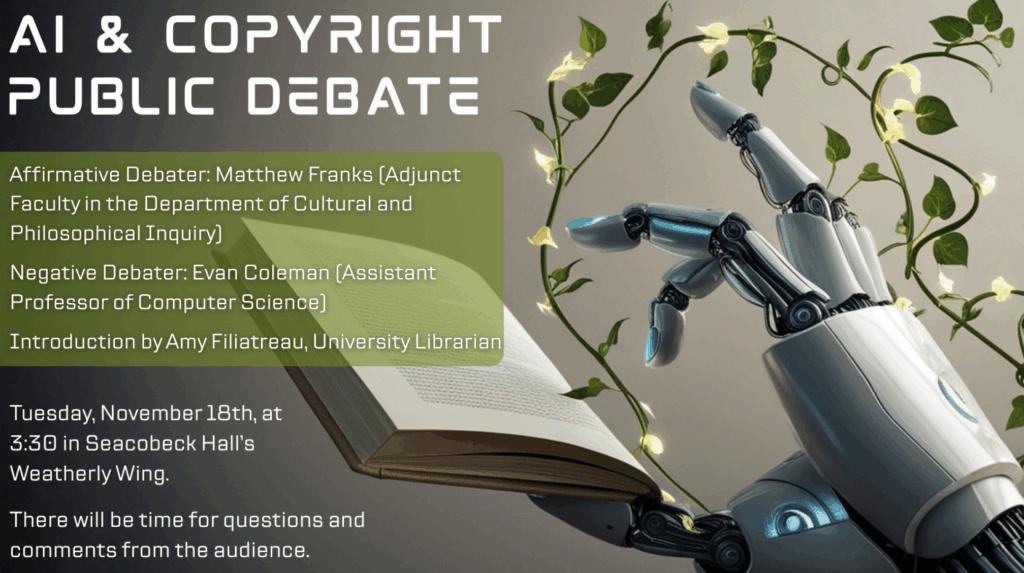
Students, faculty and staff at the University of Mary Washington gathered last month for a public debate examining a question at the center of ongoing legal and creative disputes – does training artificial intelligence (AI) models on copyrighted works without permission violate copyright law.
Hosted by UMW’s Center for AI and the Liberal Arts, the event brought together many perspectives, with faculty members from computer science and the humanities there to role-play opposing sides of the argument. Following the debate, audience members posed questions and comments and were invited to take a post-debate survey.
“This event provided an excellent opportunity to engage in an important discussion about the intersection of technology, creativity and the law,” said Professor of Communication and Digital Studies Anand Rao, who is Director of the Center for AI and the Liberal Arts. “It’s a timely and thought-provoking topic.”
UMW Librarian Amy Filiatreau opened the program by outlining the legal concepts that framed the discussion, including the four pillars of Fair Use – the purpose of use, the nature of the work, the amount used and the effect on the market. She noted that U.S. policymakers have yet to establish comprehensive regulations for AI tools, leaving decisions to the courts where disputes are currently unfolding.
Arguing the affirmative position, Matthew Franks, adjunct faculty in the Department of Cultural and Philosophical Inquiry, contended that AI companies benefit from copyrighted works in ways that require permission or compensation. He explained how AI companies claim their tools “learn” in a manner similar to humans but said the technology does not create or transform work in the same sense and may reduce opportunities for human creators.
“When an AI corporation uses copyrighted material for the purpose of generating profit, that work must at the very least by used with permission, acknowledged and compensated,” he said.
On the opposing side, Evan Coleman, assistant professor in the Department of Computer Science, argued that using copyrighted works to train AI models constitutes a transformative use under Fair Use doctrine. Coleman described the training process as the adjustment of statistical patterns rather than the copying of expressive content. He compared current concerns about AI to earlier anxieties surrounding the introduction of the VCR, radio and other disruptive technologies.
“Training is not theft. It’s research. It’s progress,” Coleman said. “We want innovative industries to keep popping up.”
After the debate, audience members commented and raised questions about deepfake technology, the impact of AI mimicking artistic styles and the implications of differing international regulations.
“The goal of the debate was not to resolve anything,” said Rao. “Some of the biggest courts in the land haven’t been able to resolve these issues. But we certainly learned a lot.”
Mary Washington’s Center for AI and the Liberal Arts is dedicated to exploring the implication of AI through the lens of the liberal arts, fostering public understanding and interdisciplinary dialogue.
*AI tools were used to assist in drafting portions of this article; all content has been reviewed and edited by a UMW staff author.