Benjamin Hermerding’15 makes a difference at UMW and beyond
Virginia Education Specialist Named UMW Educator-in-Residence
Robert Fugate ‘02, an assessment specialist for the Virginia Department of Education, has been named the University of Mary Washington’s Educator-in-Residence. He will present the keynote lecture at the College of Education’s Graduate Research Symposium on Saturday, April 25.

The symposium will be held from 9 a.m. to 12:30 p.m. at the North Building of UMW’s Stafford campus. Following Fugate’s 12:45 p.m. remarks, recognition and celebration of the 2014-2015 College of Education graduates will take place at 1:30 p.m. The event is free and open to the public.
Fugate’s talk will focus on his role as an LEP and how his experience at UMW, where he received a post-baccalaureate certificate in Teaching English as a Second Language in 2003, influenced his career.
As an assessment specialist in limited English proficiency (LEP), Fugate manages the statewide administration of the English language proficiency assessment testing program and provides technical assistance regarding LEP students’ participation in the Standards of Learning assessments.
Fugate played an integral role in representing the Virginia Department of Education as part of the World-Class Instructional Design and Assessment (WIDA) Consortium by serving on the WIDA Executive Committee. Fugate currently serves on the Steering Committee for the new online ACCESS for ELLs 2.0 test and as chairperson of a subcommittee for developing the score report for the new ACCESS for ELLs 2.0 test.
Before he accepted the position as the LEP assessment specialist in 2007, Fugate received a master’s degree in writing from Bowling Green State University. Fugate also taught middle school in the gifted and talented education program in Berkeley County, W.Va., and English as a second language to elementary school students in Chesterfield County, Va.
For more information about the symposium and keynote address, contact the College of Education at (540) 654-1034.
UMW Hosts Education Representatives
The University of Mary Washington hosted a delegation of high-level ministry and higher education representatives from eight countries on Feb. 23.
The representatives, who came to the U.S. from Iraq, Tunisia, Morocco, Saudi Arabia, Kazakhstan, Ukraine, Vietnam, and the Philippines, visited as part of the EducationUSA Leadership Institute. The EducationUSA Leadership Institute was sponsored by the State Department and the Institute for International Education.
The delegation stayed in the U.S. from Feb. 16 to 24.
The goal of EducationUSA is to bring participants from select countries and world regions to the U.S. to increase their understanding of U.S. higher education, develop the tools necessary to build capacity within their own systems, and engage with the U.S. higher education in effective, sustained ways.
-
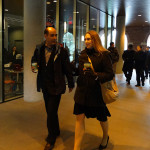
- Salah Benabdallah, director of the mission Al Akhawayan, University of Ifrane, Morocco, and Nele Feldmann, Center for International Partnerships Institute for International Education, walk together through UMW campus.
-

- Left to right: Salah Benabdallah, director of the mission Al Akhawayan at the University of Ifrane in Morocco, Cynthia Llanes, vice president for Academic Affairs at the Technological Institute of the Philippines, Beth Dennis, Department of State Bureau of Educational and Cultural Affairs, and Nele Feldmann, Center for International Partnerships Institute for International Education, warm up inside of the Information and Technology Convergence Center.
-
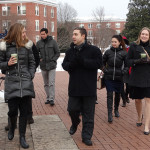
- Left to right: Nele Feldmann, Program Manager for Center for International Partnerships Institute for International Education, Mhammed Chraibi, Professor of Computer Science at the University of Ifraine in Morocco, Jose A. Sainz, associate Professor of Spanish and Director of the Center for International Education at UMW, Oleksandra Lukianeknko, Chief Specialist of International Cooperation in Ukraine, and Beth Dennis, Program Officer at the Department of State Bureau of Educational and Cultural Affairs, walk past Lee Hall at UMW.
EagleWorks Gives Small Business Opportunity to Shine
The University of Mary Washington’s Center for Economic Development is taking steps to help small businesses in Fredericksburg succeed. Its small-business incubation program, EagleWorks, took its first client in 2014.
Koji Flowers, owner of online marketing company Big Cloud Media, came to EagleWorks after moving from Texas. In the nine months Flowers has worked at EagleWorks, Big Cloud Media has tripled sales and doubled the average scope of project services. In addition, the company has clients in Mexico, Canada, India and Israel.
EagleWorks is a collaborative entrepreneur-centered program through the Center for Economic Development that focuses on small businesses to promote their growth and sustainability.
Currently, EagleWorks has 13 partners that support clients in the program, including the U.S. Small Business Administration and Cardinal Bank.
EagleWorks provides services for small business owners, including office space, a conference room for client use, and business training programs.
Flowers credits EagleWorks as a large proponent to Big Cloud Media’s success. Flowers, who had operated Big Cloud Media from his home for several years before coming to EagleWorks, was looking for a place where he could separate work from home.
EagleWorks, in addition to providing an area solely for business, also gives Flowers a venue where he can meet with potential clients.
The Executive Director of Economic Development Brian Baker and others in the department have been especially valuable to Flowers. They helped Flowers create Limited Liability Company status for his business. In addition, they helped improve his business in ways Flowers had never considered.
“It’s been a wonderful program for me,” Flowers said.
Author Discovers Founding Friendships
Friendships between men and women are usually regarded with suspicion, but Cassandra Good, associate editor of the Papers of James Monroe at the University of Mary Washington, discovered instances of genuine friendships between men and women hidden away in an unexpected time in history.

Good’s recently published book, “Founding Friendships: Friendships between Men and Women in the Early American Republic,” draws on diaries, portraits and letters between men and women who lived in the early stages of the United States’ history and explores their relationships. Some of the relationships include familiar names: Abigail Adams and Thomas Jefferson wrote letters back and forth. George Washington corresponded with a woman named Elizabeth Powel, also through letters.
Good spent nearly a decade researching friendships between men and women from 1780 to 1830. She traveled to about two dozen archives and museums all over the east coast and read letters written by men and women to each other among other documents. Some prohibitions existed against writing letters to unrelated members of the opposite sex during the late 1700s and early 1800s, but Good found substantial material.
Friendships between elite men and women, such as the one between Abigail Adams and Thomas Jefferson, had political, social and personal benefits that were not romantic in nature, an idea that Good conveys in her book.
“I argue that elite men and women in the early American republic formed loving friendships that exemplified the key values of that period: equality, virtue, freedom and choice. These friendships were building blocks of new American systems of politics, gender, and power,” said Good, whose book was published by Oxford University Press.
Good aims to show that relationships between men and women are not always limited to marriage or romance. Friendship between men and women is not only possible, but it can be healthy, she said.
“The idea of companionate marriage—that a husband and wife should be friends—started in the period I write about, and with that arose the idea that marriage should be the central place for adults to fulfill emotional needs. I think both then and now we put too much weight on marriage as the pinnacle of fulfillment,” said Good. “I hope readers will consider how it takes many different relationships and types of love to support us and make us happy.”