University Dining is anxious to get your feedback on their dining services in the Restaurants at the Top of the CRUC and in their Panera Cafe, so they are offering a $100 Visa card to the winner of the prize drawing, which will be held at the conclusion of the survey.
The survey is open to all members of the University faculty and staff through October 7th. The information being gathered is for informational purposes only. The dining team will use your responses to help guide their training, menu planning, and overall programing. No one will try to sell you anything, and your contact information will not be shared with any other group or business.
This is your chance to let your voice be heard! The survey takes about ten minutes to complete, and your responses will definitely assist the Dining team as they plan for the future. To access the survey, simply use this Survey Link, or click on the QR code below. For additional information contact Rose Benedict, 540-654-2169 or rbenedic@umw.edu.
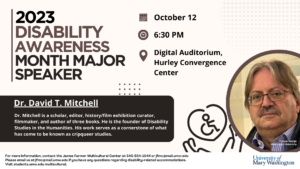 Dr. David T. Mitchell is a founder of Disability Studies in the Humanities. His work along with his partner, Sharon Snyder, serves as a cornerstone of what has come to be known as cripqueer studies. Cripqueer studies foregrounds not only disability as an identity seeking inclusion and rights, but as an active verb exposing the necessity of structural critiques of normativity. Without disability we cannot fully know how marginalized bodyminds understand it, navigate it, critique it, and expose the cracks that define normativity as forms of docility instrumental to belonging. His academic and creative filmwork pursues alternative pathways on which the designation of incapacity often turns into an unexpected capacity. Thus, the marginalization, exclusion, erasure, and destruction of cripqueer lives results in fissures of our cultural knowledge base that must be crossed by intimacies that only disability experience, theory, and the arts can provide. In their first film, “Vital Signs: Crip Culture Talks Back” (1995), Mitchell and Snyder unveiled the alternative interdependencies that inform what they call, crip culture, and deployed those non-normative practices as a critique of the Western myth of independence that is central to liberal humanist formulations of the Human. The film also demonstrated how disability queers all forms of being. Join Dr. David T. Mitchell on October 12th at 6:30 in the Digital Auditorium for a chance to hear him elaborate on these topics and be a part of the conversation.
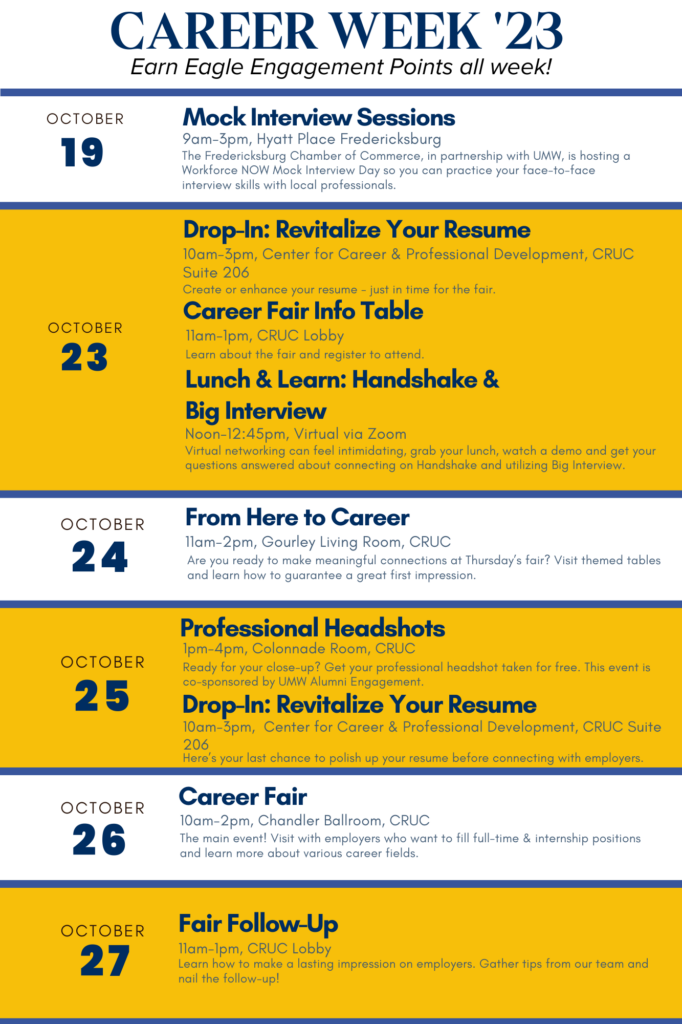 CAREER WEEK ’23