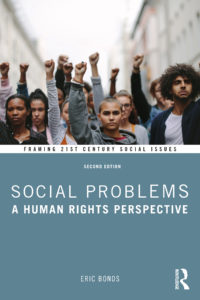
 Eric Bonds recently published a second edition of his textbook, Social Problems: A Human Rights Approach with Routledge Press. The book uses an international human rights framework as a jumping-off place to teach students about power and inequality in U.S. society. This revised and expanded edition includes new chapters on human rights and immigration, climate change, and public health. It also includes new discussions on the COVID-19 pandemic and the #BlackLivesMatter movement.
Larus Comments on Americans’ Negative Views of China
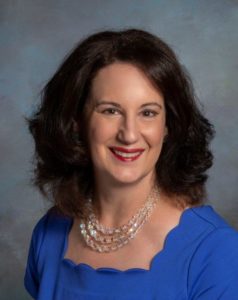
Professor and Chairman of the Department of Political Science Elizabeth Freund Larus.
PSIA Professor and Chairman Elizabeth Freund Larus commented in Courthouse news that negative rhetoric coming out of the Trump White House was not the only factor in American’s increasing negative views of China. She indicated that Americans’ once overly optimistic views of China have been trending downward amidst concerns over China’s record on politics, economics, and values. Read the article at https://www.courthousenews.com/enemy-perception-of-china-has-risen-in-america/
‘Great Lives’ Lecture Series Continues with Gandhi
The William B. Crawley Great Lives Lecture Series continues on Thursday, March 11 at 7:30 p.m. with nonviolent resistance leader Mohandas K. Gandhi, presented by Professor of Communication and Chair of the Department of Communication and Digital Studies Anand Rao. The Synergy Periodontics and Implants Lecture.
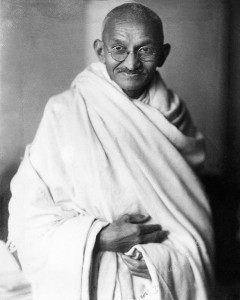
Mohandas K. Gandhi
Because of restrictions on public gatherings on campus, the entire series of 18 lectures will be pre-recorded and delivered electronically, through Zoom Webinars, with closed captioning available. Although the presentations will be taped in advance, there will still be a live Q&A session following the online debut of each lecture, in which the speaker will be available to answer questions submitted by audience members.
Once called a ‘half-naked fakir’ by Winston Churchill, Mohandas K. Gandhi was more widely known as Mahatma Gandhi, the man who led India to independence in 1947. Gandhi is typically remembered as he was in his later years, in sandals and dhoti leading protests and engaging in hunger strikes as he took on the British Empire. As with all great lives, Gandhi’s is a study in contrasts, and any study of his life, and his success as a leader of India, must include an understanding of his formative years as a boy in India, as a law student in London, and as a lawyer in South Africa. It is through this analysis that we can see how he became so instrumental to both Indian independence and our own Civil Rights movement.
Other upcoming lectures include Renaissance artist Artemisia Gentileschi, presented by Professor of Art History Marjorie Och; and playwright Lillian Hellman, presented by Professor of Theatre Gregg Stull. To learn more about Great Lives and view past and upcoming lectures, please visit https://www.umw.edu/greatlives/.
Rettinger Comments on Cheating During Remote Learning in Teen Vogue
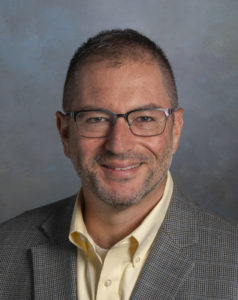
Professor of Psychological Science David Rettinger
Professor of Psychological Science David Rettinger, who is also the director of Academic Integrity at UMW, recently contributed to a Teen Vogue article about remote learning and the rise of cheating.
“I call it a game of whack-a-mole,” says David Rettinger, president emeritus of the International Center for Academic Integrity (ICAI) and director of academic integrity at the University of Mary Washington. New sites are constantly rising in popularity, he explains, making it harder for professors to prevent students from seeking answers online, especially now. Read more.
Dr. Rettinger also offered comments on the West Point cheating scandal:
A message for Student Employee Supervisors about graduating seniors
A message for Student Employee Supervisors:
The Office of Student Activities and Engagement has opened up the graduation cord nomination process for this year’s graduating seniors. As an update from past years, thanks to sponsorship from the Inter-Club Association/Finance Committee and the area of Student Involvement, we are able to provide seniors their involvement cords for free as a gift. This likely won’t be possible in future years, but we thought it would be a nice gesture this year.
Graduating seniors who have worked on campus for at least one year are eligible to receive an orange Involvement cord and/or a green Leadership cord (if they have been in a manager/leadership position as a student employee). In order for them to be eligible to pick up a cord from SAE, we ask that you fill out this form with the names of any graduating seniors in your department. Additional information about graduation cords can be found here.
Click here to complete the form.
Later in March, eligible students will receive an email notifying them to come pick up their cord(s) from SAE. If possible, please complete this form by Wednesday, March 17.
Questions can be directed to ssutphin@umw.edu.
Farnsworth Lectures on American Democracy to Malaysian Students
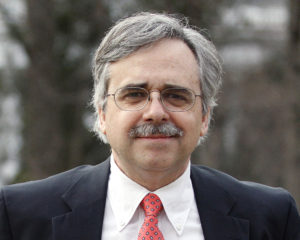
Stephen Farnsworth, Professor of Political Science and Director of the Center for Leadership and Media Studies.
Stephen Farnsworth, professor of political science and director of the University’s Center for Leadership and Media Studies, recently delivered an online lecture, “Reviewing the 2020 U.S. Elections: Challenges to American Democracy in the Post-Trump Era,” at Methodist College Kuala Lumpur, Malaysia. Dr. Farnsworth served as a Fulbright Specialist at MCKL during 2019.
Dr. Farnsworth also commented on the following news stories:
State GOP looks to using more than one site for convention (The Washington Post)
Northam Endorses Herring Rival in Attorney General Race (WVTF)
Examining Next Steps for Legislation Passed During 2021 Session (WVTF)
Effort to Eliminate Mandatory Minimums Met a Disappointing End, But Will Likely be Back (WVTF)
Ottoman Religious History Volume Publishes Al-Tikriti Chapter
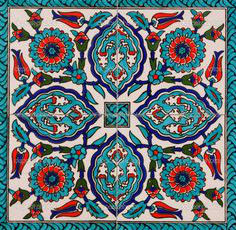 In the fall of 2020, a volume edited by Tijana Krstić and Derin Terzioğlu entitled Historicizing Sunni Islam in the Ottoman Empire, c. 1450 – c. 1750, included a chapter by UMW Middle East History Associate Professor Nabil Al-Tikriti. The chapter, entitled “A Contrarian Voice: Şehzāde Ḳorḳud’s (d. 919/1513) Writings on Kalām and the Early Articulation of Ottoman Sunnism,” provides an examination of the role Prince Korkud’s writings played in the early modern evolution of Ottoman religious identity.
The chapter abstract: “What characterizes Ottoman Sunnism, and how did it come to be? The conventional view is that by roughly the middle of the sixteenth century the imperial elite came to adopt and promote a particular religious identity, which can be characterized by several overlapping, interrelated, and historically defined denominational (madhhab) affiliations, as well as a particular relationship with the political hierarchy. The favored denominations included Hanafi legal affiliation and Maturidi kalām orientation, accompanied by elite support for particular aspects of mystical thought and practice, a cooperative relationship between favored Sufi orders and the state, and advanced integration of the ulama into a state-supported madrasa system.”
“One figure whose writings reflect this coming together of Ottoman Sunnism at a nascent stage is Şehzāde Ḳorḳud (d. 919/1513), who argued a series of positions on matters of religious belief, doctrinal certainty, favored groups, and the relationship between the state and ulama. Largely because he failed to win power in the 917–919 / 1511–1513 dynastic succession struggle, the prince’s arguments left a limited mark, and several of his positions reflected a minority viewpoint. However, at the same time, his positions highlight several relevant intellectual influences at that time and place, point to factors contributing to the form Ottoman Sunnism came to take, and demonstrate the range of debate inherent in elite circles at the time.“
Cooperman Pens Blog on Impact of Republican Party Activists on Future of Party
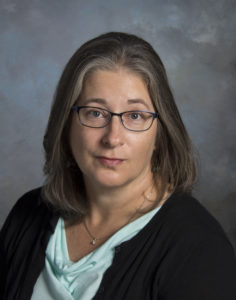
Professor of Political Science Rosalyn Cooperman
Rosalyn Cooperman, professor of political science, writes about how Republican Party activists will shape the future of the Party in the London School of Economics American Politics & Policy blog: https://bit.ly/3aTqJKp
Rao Pens Editorial on Gandhi for ‘Great Lives’ Lecture
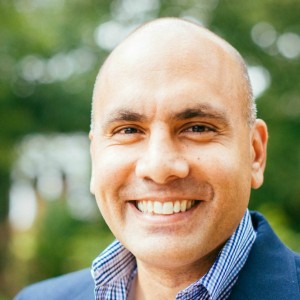
Professor of Communication and Chair of the Department of Communication and Digital Studies Anand Rao
Professor of Communication and Chair of the Department of Communication and Digital Studies Anand Rao penned an editorial on the life of Mohandas K. Gandhi, also known as Mahatma Gandhi, in The Free Lance-Star in advance of his ‘Great Lives’ lecture on Thursday, March 11. The lecture can be watched here.
WHILE touring India in 1959, Dr. Martin Luther King, Jr. visited Mani Bhavan, the house where Mahatma Gandhi had lived in Mumbai. It was in this home that Gandhi launched his Indian movement for truth and nonviolence, called satyagraha.
The home had been turned into a museum, and the upstairs room where Gandhi had slept still held his mattress and shoes. When King visited, he asked if he could spend the night in that room, saying, “I am not going anywhere else. I am going to stay here, because I am getting vibrations of Gandhi.”
The curators pulled two cots into the room, and Rev. King and his wife, Coretta Scott King, spent the night next to Gandhi’s mattress. Soon after, King told All India Radio that he had decided to adopt Gandhi’s methods of civil disobedience as his own.
Gandhi’s philosophy of satyagraha inspired development of our own civil rights movement. Dr. King returned from his trip to India committed to employing a Gandhian strategy of nonviolence.
But Dr. King was not the only civil rights leader to follow Gandhi’s philosophy. While Dr. King was introduced to Gandhi and his practice of nonviolent protest in the late 1940s, James Farmer started following the teachings of Gandhi as early as 1940. Farmer employed the techniques and practice of satyagraha in the first civil rights sit-in in Chicago in 1942. Read more.
Subramanian’s New Book Reviewed in Discover Magazine
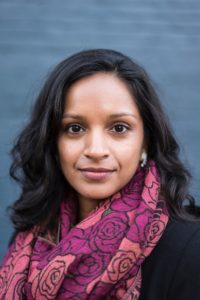
Assistant Professor of Communication Sushma Subramanian
Assistant Professor of Communication Sushma Subramanian recently released a new book, How to Feel: The Science and Meaning of Touch, and was interviewed in Discover Magazine.
As Subramanian explains in her book, How to Feel: The Science and Meaning of Touch, it was a moment when she began to consider how little she knew about this multifaceted sense — “a capacity,” she writes, “that never shuts off.” The questions kept forming, eventually leading Subramanian, a professor of journalism at the University of Mary Washington, to write an article for Discover in 2015 about the development of tactile touch screens — which use haptic technology, such as vibrations in handheld devices.
In her latest work, she dives deeper into that world, but also explores the limits of our sense of touch and what makes it so versatile. Discover caught up with Subramanian to talk about touch in the age of COVID-19, the future of tactile research and how we experience the sense differently across personal and cultural barriers. Read more.