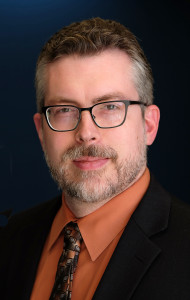
Janie Lee, Assistant Professor of Linguistics, recently received an Emerging Diversity Scholar citation from the University of Michigan’s National Center for Institutional Diversity. This citation is awarded to early career scholars with outstanding potential to contribute to diversity-related research, practice, and/or teaching. As an NCID Emerging Diversity Scholar, Lee’s work will be promoted through the NCID website.
Cooking up a Dynamic Web Presence
Director of Digital Communications Shelley Keith has come to UMW on a mission: to help the campus community share its stories through an effective and engaging web presence.
Keith, a native of Arkansas, has a background in web design and development, content management, project management, and social media marketing. She started her career as the development director for a small IT company, where she managed external and internal development projects for nearly a decade. Before joining UMW in May 2013, she worked at Southern Arkansas University in various positions, including most recently as manager of web communications and marketing. She is active in the higher education web field and frequently shares her expertise at conferences and workshops, especially her knowledge of WordPress.
In a recent interview, Keith explains her role, her philosophy of the web, and what she sees as the strengths of UMW:
How do you see your role as Director of Digital Communications? What are your main responsibilities?
Essentially, my mandate is to facilitate an “effective web presence” for the university. This goes a great deal beyond providing technology support and keeping the software up to date – we’re here to help departments and individuals tell their part of the UMW story. Our job is supporting efforts and initiatives of campus constituents, be it academic, recruiting, fundraising, etc.
When faculty are doing amazing things in the classroom, or groundbreaking research, or supporting students in ways that are going to change lives…how do we support that work in ways that also support recruiting, retention, grant funding, student success, awareness, and even community involvement? Those are the things I think about constantly. What can I do to make sure these great things aren’t sitting on a shelf somewhere, unknown? How can we go beyond feature stories and press releases to truly utilizing all of the amazing work being done on campus and support that work in more effective ways?
What is your philosophy regarding the Web?
The web is the single most utilized communications tool in the university’s toolbox. We are all caretakers for some portion of the UMW story, the web gives us a platform to tell that story in context to support the mission and goals of the institution, support students, and uplift the community. It’s important we focus on ensuring we’re purposeful, authentic, and responsive to user needs.
As someone relatively new to the university, what do you see as its strengths?
I can’t speak highly enough of the engaged community on this campus. We have a culture here that many schools aspire to! Everyone here cares about the institution, the students, the mission, and contributing to their respective fields. I’ve yet to meet anyone here who “phones it in” so to speak. That’s incredible! For me, it’s a treasure trove. People who are engaged with the institution want to do great work, and, as far as the web is concerned, all I need to do is give them the right perspective, tools, and support to effectively tell their stories as part of the greater UMW community.
What are the areas where there is room for improvement? How do you plan to address those needs?
Think about the website like a kitchen. There are drawers and cabinets and counter space, but those are only helpful if they’re uncluttered and organized. Right now the UMW site is a highly utilized kitchen with some overstuffed drawers. Visitors come in and can find some of what they need if they dig long enough, but it’s not a particularly easy experience.
The goal is to clear out the dead batteries and broken spatulas (and why in the world do we have 3 different incomplete sets of silverware and two broken Foreman grills in here!?) and get back to providing the tools and information users really need in a manner that doesn’t require excessive effort. I’m all about giving our audience what they need where they expect it.
To receive the latest updates from Shelley and the web team, UMW site managers should sign up for the webmaster newsletter.
Reynolds Named to Fulbright Reviewing Committee
The Institute of International Education (IIE) annually conducts scholarship competitions for U.S. graduate students wishing to pursue study, research or professional training abroad under the Fulbright-Hays Program sponsored by the United States Department of State and for other awards offered by foreign governments, universities and private donors. To assist in the selection of candidates, the Institute convenes a National Screening Committee comprised of area specialists and authorities in various fields to review applications and nominate candidates to the award sponsors. Dr. Patricia Reynolds, Assistant Professor in the College of Education, has been selected to work this year on the National Screening Committee for English Language Teaching Assistants for Western Europe.
Barrenechea Co-Edits Journal Issue, Presents at Conference
Over the summer, Antonio Barrenechea, Associate Professor of English, co-edited and co-wrote the introduction for “Hemispheric Indigenous Studies, ” a special issue of Comparative American Studies: An International Journal. In August, he attended the Sixth World Congress of the International American Studies Association (IASA) in Szczecin, Poland, where he presented “Thomas Pynchon’s Poetics of Atrocity: Making Words Matter in Gravity’s Rainbow.” At that conference, he was also elected to a two-year term as a member of the Executive Council of the IASA.
Rafferty Publishes Creative Essay on McKinley Assassination
Colin Rafferty, Assistant Professor of English, recently published the essay “Assassin’s Bullet (#25)” in the latest issue of Shadowbox Magazine: http://www.shadowboxmagazine.org/issue7/Bottle12.swf.
Sally Scott Presents at AHEAD Conference
Sally Scott, director of the office of disability resources, and Dr. Manju Banerjee, vice president of research at Landmark College, recently presented a paper Foreign Language Accommodation: Incorporating Evidence-Based Practices under the AHEAD Documentation Guidance, at the annual conference of the Association on Higher Education and Disability in Baltimore, Md.
Stephen Farnsworth Publishes New Book
Stephen Farnsworth, professor of political science and director of the University’s Center for Leadership and Media Studies, is coauthor of new book, “The Global President: International Media and the U.S. Government,” published this month by Rowman & Littlefield, a scholarly publisher in the social sciences.
From the publisher: “This book provides an expansive international examination of news coverage of US political communication, and the roles the US government and the Presidency play in an increasingly communicative and interconnected political world. This comprehensive yet concise text includes analyses of not just the Presidency, but US foreign policy and contemporary political media itself. The realities of an ever-changing political landscape are magnified nowhere more greatly than in the realm of foreign policy, and the stakes surrounding the need for quality communication skills are no higher than at 1600 Pennsylvania Avenue because – when the voices of the US government speak – the world is listening.”
More information: http://stephenfarnsworth.net/books/
Charlie Sharpless Receives NSF Grant to Study Fate of Marine Oil Spills
Recent research shows that oil in marine systems ages in ways inconsistent with current models. Specifically, the hydrocarbon fraction has long been assumed to get oxidized, become more water soluble, and then biologically or abiotically degrade, eventually to CO2. Researchers at the Woods Hole Oceanographic Institution have discovered that oxidized hydrocarbons actually constitute a sizable portion of the recalcitrant tar that remains at the late stages of a spill. This process is presumably important in the weathering of natural oil seeps as well, which constitute the majority of oceanic oil. Charlie and colleagues at Woods Hole and the University of California, Santa Barbara have received funding from the National Science Foundation, Division of Chemical Oceanography to study the extent to which photochemical and microbial processes drive this oxidation process. The project, entitled “Oxygenation of Hydrocarbons in the Ocean” is a three-year study that will provide opportunities for UMW students to travel to and study at WHOI and UCSB as well as participate in a cruise in the Gulf of Mexico to sample oil at various stages of weathering.
Chris Foss Publishes Book Chapter
Chris Foss, professor of English, has published a chapter entitled “Oscar Wilde and the Importance of Being Romantic” in Wilde Discoveries: Traditions, Histories, Archives. The book is a collection of essays from the University of Toronto Press (Canada’s foremost university press) edited by Joseph Bristow (one of the most renowned Wilde scholars in the world today). Foss’s chapter delineates how Wilde’s American lecture “The English Renaissance” establishes that, for Wilde, a properly Romantic aesthetics is antisystematic and disseminative in nature, emphasizing parody and process over self-realization and synthesis. Casting Wilde as a Romantic Ironist rather than a Romantic Egoist productively illuminates how the insincerity that for many so defines the mature Wilde actually is an extension, rather than a rejection, of the Romanticism he emphatically embraced at the beginning of his career.
Eddie Perry Named President of VACLEA
Eddie Perry, chief of police, was recently voted president of the Virginia Association of Campus Law Enforcement Administrators (VACLEA). Chief Perry has previously served in other positions with the organization, most recently as vice president. VACLEA was started in 1973. It is a non-profit organization whose purpose is to promote professionalism in the field of law enforcement among the universities and colleges of Virginia, thereby establishing a climate conducive to the achievement of academic excellence.
For more information about VACLEA, visit http://www.vachiefs.org/index.php/affiliate_organizations/vaclea/ or Facebook https://www.facebook.com/pages/Virginia-Association-of-Campus-Law-Enforcement-Administrators/362741047112674.