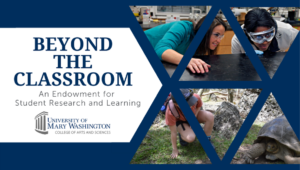
You know firsthand the value of high-impact learning experiences at Mary Washington — undergraduate research, independent study, study abroad, and internships. We created the Beyond the Classroom Endowment to ensure that UMW students will always have these meaningful opportunities to apply and expand their learning.
I am grateful to Dr. Cathie Woteki ’69 and her husband Tom Woteki for matching all gifts to the Beyond the Classroom Endowment through the end of July. Generous donors have already given more than $26,000 since the match was announced in late May, and their total impact exceeds $50,000 thanks to this dollar-for-dollar match. Overall, we are about two-thirds of the way to our target of $250,000 by the end of 2021, with an ultimate goal of $1 million.
I hope you will take a moment to hear about the impact of gifts to the Beyond the Classroom Endowment in this short video message from Cathie. If you have not already given, please consider donating before the match ends July 31. Thank you for all of the ways you support Mary Washington students!
With gratitude,
Dr. Keith Mellinger, Dean
College of Arts and Sciences
P.S. Read more about Cathie and the match in this story.
Make Your Gift for the x2 Match
 SAE is planning to have its annual Eagle Resource Fair on Wednesday, August 18th from 12:00pm – 3:00pm in Chandler Ballroom. If you (or someone you may know) would like to promote your organization, business or office to our incoming freshman and transfer students, this would be the perfect event to do so! You can register at:
  The Presidential Emerging Leaders Program is looking for facilitators!
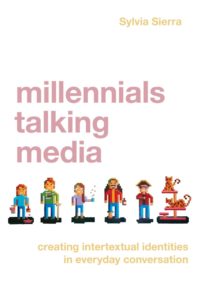 “This book examines how a group of U.S. Millennial friends in their late twenties embed both old media (books, songs, films, TV shows) and new media (YouTube videos, video games, and internet memes) in their everyday talk for particular interactional purposes. Multiple case studies are presented featuring the recorded talk of Millennial friends to demonstrate how and why these speakers make media references in their conversations. These recorded conversations are supplemented with participant playback interviews, along with ethnographic field notes. The analysis demonstrates how the speakers phonetically signal media references in the speech stream, how they demonstrate appreciation of the references in their listening behaviors, and how they ultimately use media references for epistemic, framing, and identity construction purposes, often (but not always) when faced with epistemic, or knowledge, imbalances as well as interactional dilemmas, or awkward moments in interaction. The analysis shows how such references contribute to epistemic management and frame shifts in conversation, which is ultimately conducive to different forms of Millennial identity construction. Additionally, this book explores the stereotypes embedded in the media that these Millennials quote, and examines the effects of reproducing those stereotypes in everyday social life. This book explores how the boundaries between screens, online and offline life, language, and identity are porous for Millennials, and weaves together the most current linguistic theories regarding knowledge, framing, and identity work in everyday interaction, illuminating the interplay between these processes.”
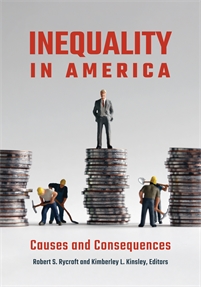 On June 30, College of Business Senior Lecturer Kimberley Kinsley and Professor of Economics Robert Rycroft will have a book published, Inequality in America: Causes and Consequences, Santa Barbara, CA:ABC-CLIO.