Professor of English Chris Foss was among a panel of experts featured in a new WalletHub article, “2016’s Best and Worst Cities for People with Disabilities.” He offered answers to questions about the financial challenges facing persons with disabilities, the top five indicators in evaluating the best cities and the policies/programs that increase inclusion and quality of life. You may access the piece at: https://wallethub.com/edu/best-worst-cities-for-people-with-disabilities/7164/#chris-foss
Foss Presents Pedagogy Paper in Cardiff, Wales
On Sept. 1, Professor of English Chris Foss presented a paper with an unfortunately long-winded (though appropriately Victorian) title, “Consuming The Yellow Book: On the Decadent Pleasures and Aesthetic Perils of Exploring the Contemporary Afterlife of the Fin-de-Siècle Literary Scene through a Fully Online Summer School Course,” at the British Association for Victorian Studies annual conference, held this year in Cardiff, Wales.
This pedagogy-focused paper provided a tour of the UMW Blogs and VoiceThread websites through which students discussed their readings and presented their work for his May/June 2016 online course ENGL 375B4, Late Victorian Decadent Literature—a course revolving around the groundbreaking avant-garde literary magazine The Yellow Book, the complete digitized volumes of which are available through the wonderful electronic resource The Yellow Nineties Online.
Overall, Foss suggested that digital means of consuming the Victorians hold more pleasures than perils, for instructors and students alike, and that such formats should play an increasingly important role in the contemporary afterlife of Victorian studies.
Foss and Whalen Co-edit Essay Collection
Professor of English Chris Foss and Associate Professor of English Zach Whalen (together with Jonathan W. Gray, Associate Professor of English at John Jay College/City University of New York) have published a book of essays titled Disability in Comic Books and Graphic Narratives. The book appears as part of Palgrave Macmillan’s Literary Disability Series (series editors David Bolt, Elizabeth J. Donaldson, and Julia Miele Rodas).
This book invites readers to consider both canonical and alternative graphic representations of disability. Some chapters focus on comic superheroes, from lesser-known protagonists like Cyborg and Helen Killer to classics such as Batgirl and Batman; many more explore the amazing range of graphic narratives revolving around disability, covering famous names such as Alison Bechdel and Chris Ware, as well as less familiar artists such as Keiko Tobe and Georgia Webber. The volume also offers a broad spectrum of represented disabilities: amputation, autism, blindness, deafness, depression, Huntington’s, multiple sclerosis, obsessive-compulsive disorder, speech impairment, and spinal injury. A number of the essays collected here show how comics continue to implicate themselves in the objectification and marginalization of persons with disabilities, perpetuating stale stereotypes and stigmas. At the same time, others stress how this medium simultaneously offers unique potential for transforming our understanding of disability in truly profound ways.
Foss Presents Paper Celebrating the Work of Claudia Emerson
On Nov. 13, Professor of English Chris Foss presented a paper titled “‘The body’s own account’: Disease, Disability, Death and the Argument for Life in the Poetry of Claudia Emerson” at the South Atlantic Modern Language Association annual convention in Durham, N.C. The paper celebrates Claudia’s unflinching consideration of disease, disability and death in her most recently published book, Impossible Bottle, a work throughout which Claudia consistently refuses to airbrush the experience of pain and suffering while simultaneously refusing to succumb to despair.
Indeed, Impossible Bottle powerfully testifies to the meaningfulness and the value of all lives touched by disease, disability and death. Ultimately, Claudia discards any vision of some sort of final disconsolate decline in the face of a dogged disease like cancer, or some sort of defeatist surrender to a death without dignity, and instead gifts us all with a brilliant argument for life that not only envisions but also enacts a truly compelling embodiment of a heartening resilience that remains elastic, fresh and enlightening.
Foss Speaks to Columbia University Seminars
On October 16, Professor of English Chris Foss was a featured speaker at the joint meeting of the Columbia University Seminar on Disability, Culture, and Society and the Columbia University Seminar on Narrative, Health, and Social Justice in New York. Along with fellow co-editor Jonathan W. Gray, he talked about their essay collection Disability in Comic Books and Graphic Narratives, forthcoming in February as one of the first volumes of Palgrave’s new Literary Disability series.

They also each offered detailed presentations on their individual chapter contributions to the book. As Foss explained, his chapter, “Reading in Pictures: Re-visioning Autism and Literature through the Medium of Manga,” considers the prospect that manga texts provide a more material means through which to communicate the lived experience of autism, perhaps even encourage a more properly “autistic” reading experience. Exploring how the more conceptual and less linear qualities of Keiko Tobe’s multi-volume series With the Light: Raising an Autistic Child (together with the multimodal reading experience they foster) speak to numerous aspects of autistic embodiment, the chapter effects an open-ended critical articulation of autism and manga (in dialogue with both autistic writers and sequential art scholars) characterized by a mapping around of space from which to consider multiple possibilities.
Sorely missed was third co-editor and lead author of the book’s Introduction, Associate Professor of English Zach Whalen, who was unable to attend because he coincidentally had to be in New York that same day for the meeting of the Modern Language Association’s Committee for Information Technology.
Foss Invited to Join Editorial Board
Professor of English Chris Foss recently accepted an invitation to join the editorial board of Journal of Literary and Cultural Disability Studies (Liverpool University Press/Project MUSE). The journal is one of the two most important venues for scholarly work in the interdisciplinary field of disability studies (together with Disability Studies Quarterly), and it is the key periodical (as its name might imply) for work in literary and cultural disability studies in particular. Its editorial board consists of 50 internationally recognized cultural disability scholars.
Foss Publishes Article on Pedagogy in Pedagogy
Professor of English Chris Foss just has published an article entitled “Individual Redemption through Universal Design; or, How IEP Meetings Have Infused My Pedagogy with an Ethic of Care(taking)” in the latest number of Pedagogy: Critical Approaches to Teaching Literature, Language, Composition, and Culture. Pedagogy is published by Duke University Press and describes itself as “an innovative journal that aims to build a new discourse around teaching in English studies.”
In this article Foss addresses how participating as a parent in the Individualized Education Program (IEP) process has helped to transform his approach to teaching by reinforcing how important it is to endorse a pedagogy that recognizes and values the individuality of students. In attempting to bring both format and delivery in line with the principles of Universal Design for Instruction, Foss relates how he has come to understand such a pedagogical orientation not simply as a generic model for “good teaching” but also more particularly as a reflection of a disability-inflected pedagogy of care(taking).
Foss Publishes Article on Indian English-Language Poetry and the Irish Question
This summer, Professor of English Chris Foss published an article entitled “Fin-de-Siècle Indian English-Language Poetry: British Imperialism, India, and the Irish Question” in English Literature in Transition, 1880-1920. Now in its 58th year, ELT is one of the most established venues for scholarly work on literature from the late Victorian, Edwardian, and early Modernist periods.
In this article, Foss details how three Indian English-language poets living and publishing in India during the 1890s—Avadh Behari Lall, Aurobindo Ghose, and Romesh Chunder Dutt—wrote in support of Irish Home Rule, and how their work meaningfully counters the orientalist assumption/insistence that Indian English-language poetry limit itself to exclusively Indian contexts/foci. Such an international scope, while complementary to the more properly local focus of most Indian anti-imperialist agendas, significantly reveals the extent to which their poetry contained a cosmopolitan component that ultimately cannot be reduced to some sort of partial engagement with Irish nationalism merely as a means of covertly commenting on India. Their work suggests the global reach of Indian English-language poetry, displaying a broad range of responses to the Irish Question while offering truly penetrating individual insights into the nature of imperial rule and the politics of British imperialism beyond the “borders” of the Indian subcontinent.
Foss Presents Paper on Oscar Wilde
Professor of English Chris Foss presented a paper, “‘He is so ugly that he might have made the King smile’: Disability and Materiality in Oscar Wilde’s ‘The Birthday of the Infanta’” at the annual meeting of the Nineteenth Century Studies Association, held this year in Boston, Massachusetts on Saturday, March 27.
Foss explored how reading Wilde’s fairy tale as a critical rewriting of Charles Dickens’s The Old Curiosity Shop invites readers to (re)experience littleness/disability from within the context of Victorian freak show dynamics. Dickens’s novel is the story of how a very beautiful and impossibly good 13-year-old girl, Little Nell, is hounded to her grave by the ugly, deformed dwarf Daniel Quilp; conversely, Wilde’s story is about an ugly, deformed dwarf whose tragic death is hastened by a very beautiful and surprisingly cruel 12-year-old girl, the Infanta.
Overall, in spite of his own aversion to sentimentality in general, and to Dickensian sentimentality in particular (Wilde once quipped, “One must have a heart of stone to read the death of Little Nell without laughing”), Wilde encourages a sincerely sympathetic response to his dwarf, not only drawing him as a kind and gentle soul but actually positioning him in the role of true lover. While the dwarf’s sad fate may seem to foster a sense of hopelessness about the general cultural detachment from (if not actual delight in) the dehumanization of freaks/human oddities, Wilde’s fairy tale remains a significant text for its powerful representation of the terrible cruelty inherent in the nondisabled abjection of the disabled body as an undesirable and, ultimately, disposable thing. What is more, Wilde shows himself to be a writer fully aware of his own role as manipulator /showman/exploiter of his characters who asks readers both to recognize his authorial complicity in the consumption of pain but also to acknowledge their own complicity in this as readers/spectators/consumers.
Foss Presents Paper at International Conference on Romanticism
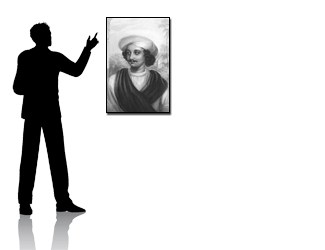
Figure talking about Kasiprasad Ghosh
On Saturday, Sept. 27, Professor of English Chris Foss presented a paper at the annual meeting of the International Conference on Romanticism, held this year in Minneapolis, Minnesota. His talk was entitled “The (Western?) Mirror and(/or?) the (Eastern?) Lamp: Romantic Reflection, Rejection, and Revision in Kasiprasad Ghosh’s The Sháïr and Other Poems.” After begging forgiveness re: his embarrassing weakness for parentheses and question marks in titles, Foss argued that Ghosh’s Sháïr (1830), as the very first volume of English-language poems published by a Hindu writer, is an absolutely essential text to be accounted for within any full consideration of the international aspects of Romanticism in general and/or the question of Romantic reflections in particular. Along the way, he teased out some of the various possibilities whereby one may position Ghosh as uncritically reflecting back the British orientalist version of Indian poetry, carefully revising and subtly transforming orientalist poetics into a new hybrid expression, and/or ultimately rejecting orientalism in favor of a distinctly transgressive and properly Indian poetics of resistance. The theme of this year’s conference in the Land of Sky-Blue Waters (and, more particularly, in the Twin Cities) was, appropriately enough, “Romantic Reflections: Twins, Echoes, and Appropriations.”