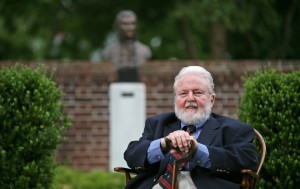
John Pearce photographed at James Monroe Museum in Fredericksburg. Photo by Norm Shafer.
The following message is from the Office of the Provost.
The University of Mary Washington regrets to announce that John N. Pearce, former senior lecturer in historic preservation and director emeritus of the James Monroe Museum and Center for Historic Preservation, died on October 14, 2019, following a long illness.
Pearce’s 27 years of service at Mary Washington began in 1984. In addition to teaching courses in the historic preservation department, he played a key role in developing the University’s museum studies curriculum. During Pearce’s tenure as director of the James Monroe Museum, the museum expanded and enhanced its programs, increased its scholarly activity, improved its facilities, and strengthened connections to the University. Pearce also directed the Germanna site of the Enchanted Castle, home of the royal Lieutenant Governor Alexander Spotswood.
Within the Fredericksburg community, Pearce served on several boards including the Fredericksburg Area Museum, the Memorial Foundation of Germanna Colonies in Virginia, Inc., and the Historic Fredericksburg Foundation. As a member of St. George’s Episcopal Church, he was active in the church’s renovations, archives committee, and choir, and frequently spoke on history.
Among many honors, Pearce received the Governor of Maryland’s Award and the Trustee of America Award. In 2011, he received the prestigious History Award from the National Society of the Daughters of the American Revolution, given for lifetime contribution to American history, and awarded to only seven Americans each year. Articles by Pearce appear in numerous publications, such as the Dictionary of American History, Encyclopedia of World Art, and Encyclopedia of Local History. He authored American Painting 1560-1913 (McGraw-Hill, 1964).
Pearce is survived by his son David Scott Pearce of Washington, D.C., and daughter Hannah Phillips Pearce of Charlottesville, VA.
A funeral service will be held at 11 a.m. Monday, October 21, at St. George’s Episcopal Church, Fredericksburg.
Nina Mikhalevsky
Provost
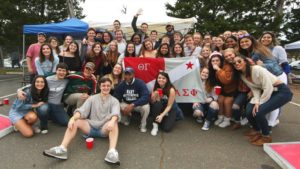 It’s that time again…time for tailgating, cheering on your Eagles, and reconnecting with your alumni family. It’s Homecoming!