PCOW’s Wellness Sector Explained: Mental
 Last fall we introduced the PCOW’s Wellness Wheel and the six dimensions of wellness: Occupational, Social, Mental, Physical, Financial, and Spiritual. Previous PCOW articles in the Eagle Eye explained the Physical and Social dimensions. Today we will introduce and explain another dimension: Mental.
Mental wellness combines the aspects of “emotional well-being and intellectual curiosity.” This wellness dimension includes “being attentive to one’s thoughts, feelings, and behaviors,” whether they are “positive or negative.” It also includes “the ability to approach life optimistically and with resiliency despite life’s inevitable disappointments.” How do we approach our day or individual tasks, do we know why we are thinking a certain way? And more importantly do we know how to change those thoughts and emotions? Let’s start looking at our stumbling blocks as stepping stones in our lives! UMW faculty and staff have access to mental health services via the Employee Assistance Program (EAP) and CommonHealth. More information about those services can be found at this link for UMW Work – Life Balance/Wellness.
How can we define Mental Wellness in our lives every day? One avenue is to look for “ways to expand one’s knowledge and skills.” Try a new hobby, mix it up with reading different genres, or in terms of intellectual curiosity take a class. UMW employees can audit UMW classes, or receive reimbursement benefits for UMW college courses after working at UMW for one year. For more information visit the HR website: Tuition Assistance.
“Write it on your heart that every day is the best day in the year.” ~Ralph Waldo Emerson
Farmer Legacy 2020 Co-Chairs Johnson & Landphair Speak with WVTF Radio IQ
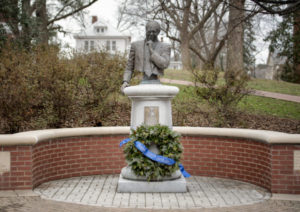
A wreath on the James Farmer bust on UMW’s Campus Walk recognizes Farmer’s 100th birthday and UMW’s Farmer Legacy 2020 celebration. Photo by Tom Rothenberg.
Farmer Legacy 2020 co-chairs Sabrina Johnson, Vice President for Equity and Access and Chief Diversity Officer, and Juliette Landphair, Vice President for Student Affairs, were recently interviewed on WVTF Radio IQ, an NPR affiliate, about civil rights icon and late Mary Washington professor Dr. James L. Farmer Jr. and UMW’s yearlong celebration of his life and legacy that launched in January, on the day after the 100th anniversary of his birth.
Johnson spoke of the impact Farmer had as a professor. “He touched the lives of so many students,” she says. “It was the most popular class on campus. It brought in historic numbers.”
Landphair spoke of Farmer’s concern that those who led the civil rights movement would someday be forgotten. “There’s a danger sometimes or a risk when you just reflect and celebrate as if the story is over. We have to hold on and protect and not backslide when it comes to the progress that’s been made.” Read more.
Annual Alcohol and Drug Reports
The following message is from the Vice President for Student Affairs:
To Members of the UMW Community:
I am writing to bring to your attention an important institutional responsibility: to maintain and communicate our established alcohol and drug policies.
The Higher Education Act of 1965 (as amended by the Safe and Drug-Free Schools and Communities Act of 1994) requires that any institute of higher education receiving federal financial aid, such as the University of Mary Washington, must adopt and implement a program to prevent the use of illicit drugs and the abuse of alcohol by students and employees.
Drug and alcohol prevention information is accessible on UMW’s website at https://students.umw.edu/studentconduct/. An “Alcohol & Drug Reports & Notifications” tab can be found on the left side of the referenced website. Students and faculty/staff are encouraged to review this information. The topics covered include: 1) Standards of conduct related to alcohol and drugs; 2) Legal sanctions; 3) Health risks associated with the use of illicit drugs and the abuse of alcohol; 4) Drug and alcohol counseling, treatment, rehabilitation, and re-entry programs; and 5) Disciplinary sanctions. Clicking on the tab will lead to both an Annual Notification (February 2020) and a Biennial Report (February 2020). The latter document contains information concerning what actions were taken in 2017-18 and in 2018-19 related to alcohol and drug prevention, what the results were, and what further actions are planned.
Please do not hesitate to contact the Office of the Vice President for Student Affairs (540-654-1062) or the Office of Student Conduct and Responsibility (540-654-1660) if you have questions regarding this material.
Juliette Landphair, Ph.D.
Vice President for Student Affairs
Bales Interviewed about Cubs, Research and Impending Retirement
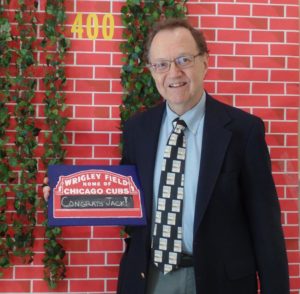
Jack Bales at the celebration held by the University of Mary Washington in honor of his new book. Photo Credit: Erin Wysong.
Reference and Humanities Librarian Jack Bales was recently interviewed by his alma mater, the University of Illinois’ School of Information Sciences, about his research, impending retirement and his lifelong passion for the Chicago Cubs.
As baseball teams gear up for spring training this month, Jack Bales (MS ’74) will begin another season of following—and researching—the Chicago Cubs, a team whose history he knows well. Bales, a reference and humanities librarian, combined his expert research skills and interest in the Cubs to author a book on the team’s early history. His book, Before They Were Cubs: The Early Years of Chicago’s First Professional Team, was published last spring by McFarland & Company.
“It took years of research and writing (I have a full-time job), and since some of the newspapers I needed to consult are not available online, I spent several years going through microfilm page by page and year by year,” Bales said. “I would spend every Christmas vacation camped out by the library’s microfilm reader-printers. One of my colleagues still remembers how she came in one day when I wasn’t there and noticed my CD player, sweater, water bottle, snacks—and even my bedroom slippers—all neatly arranged beside reels of microfilm.” Read more.
Foss Publishes Book Review

Professor of English Chris Foss
Professor of English Chris Foss has published an approximately 1600-word book review of Chris Gabbard’s A Life Beyond Reason in the most recent number of the journal Eighteenth Century Studies. Gabbard was hired out of Stanford by the University of North Florida because of his expertise in the literature of the British Enlightenment. His book, however, is no scholarly monograph on the Age of Reason, but rather a moving personal memoir chronicling his family’s life and times in their own very different Augustan Age, a period which commenced with the birth of his son August. This amazing boy lived for 14 years facing a litany of diagnoses stemming from the complications of an obstructed labor: “cerebral palsy, spastic quadriplegia, profound mental retardation, cortical visual impairment, microcephaly, seizure disorder, osteopenia—and the list went on” (35). There is pain and suffering aplenty in this narrative, along with understandable doses of anger and frustration, but above all this is a story about love and joy, and long before one reaches the final page it is abundantly clear that Gabbard’s Augustan Age has not ended with an untimely death from pneumonia; the child lives on not only in the author’s memory, but through this book in the hearts and minds of every reader who meets him and comes to appreciate the many lessons a life beyond reason holds for all.
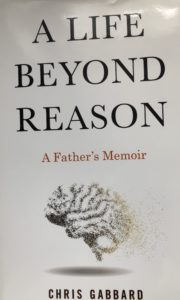
A Life Beyond Reason book cover
Socrates’s dictum that “the unexamined life is not worth living” (11) serves as the pivot upon which Gabbard transforms his whole understanding of what matters in life, for August’s cognitive capacity prevents him from ever being able to examine his life in this way, and yet Gabbard finds plenty of worth in the pleasure August not merely experiences but expresses through shrieks of glee and squawks of delight, through his contagious laughter. Gabbard credits disability rights activist Harriet McBryde Johnson, and her public debates with philosopher Peter Singer, as crystalizing his new position on what exactly constitutes a life worth living. Singer’s position on decriminalizing child euthanasia is based on a belief that disabled lives “will be permeated with suffering and therefore will not be worth living” is informed by a belief that equates personhood with “characteristics like rationality, autonomy and self-consciousness” (100). The accomplished and articulate Johnson not only embodied how an individual’s life with a severe disability is anything but “intrinsically suboptimal” (100), but she further revealed how relationships with such persons, far from being worthless, can in fact be “profoundly beautiful” (103).
Gabbard offers Coleridge likely would judge him (as he did Wordsworth’s Betty Foy from “The Idiot Boy”) as an “impersonation of an instinct abandoned by judgment,” for “what is love,” he continues, “if not ‘instinct abandoned by judgment’?” (104). With this epiphany, life beyond reason in his own Age of Johnson/Augustan Age clarifies “it is not the unexamined life that is not worth living but the life without love” (104). Drawing on the “land of interdependence” he finds in Donne’s “Meditation 17” (85), Gabbard posits his shared experiences with his son constitute “a mutually beneficial ethics of care” (108). Attuned to “August’s little ways”—“the twitch of his lips, the shift of an eyebrow,” his grins and grimaces, his fussing and laughing—Gabbard views their connection not as “adhering to a so—called custodial care model” but instead as “characterized neither by his dependence on me not by my surrender of independence to him” (108). That is, while they “depended upon one another in radically different ways,” the father’s caregiving was anything but “selfless”: “I needed him as much as he needed me. If I didn’t love him, all of this effort would have been a grudging sacrifice. But he made me happy, and, so, in our peculiar way, we split everything down the middle” (109).
Blevins Speaks to Virginia Farm Bureau Growing Leaders

Assistant Professor of English Brenta Blevins
Brenta Blevins, Assistant Professor of English, recently delivered a presentation and workshop to the Virginia Farm Bureau’s Growing Leaders Academy on “Digital Identity and Social Media” in Blacksburg, VA. Blevins spoke about how agricultural businesses can use social media to promote rural and farm-based agricultural endeavors.
Board of Visitors Public Comment Session
The University of Mary Washington Board of Visitors will hold a public comment period at 3 p.m., February 20, in the ballroom of the Jepson Alumni Center, 1119 Hanover Street. This will be a time for members of the University community, as well as members of the public, to share their thoughts with Board members.
To sign up for a three-minute time slot, go to www.umw.edu/bov/public-comments/.
Larus Comments on Romney Impeachment Vote
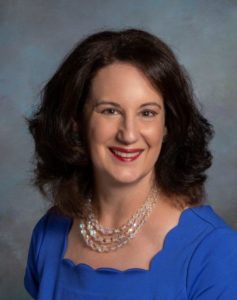
Professor of Political Science and International Affairs Elizabeth Larus
Elizabeth Larus, Professor of Political Science and International Affairs, offered comments to MEAWW news on Senator Mitt Romney’s historic impeachment vote. Professor Larus believes that the Utah senator will run in the upcoming polls, and although there are some voters in Utah who will come out to vote against Romney, he need not worry about his political standing in the state.
“Romney is likely to run in 2024,” she said. “The 2024 poll is far enough out that his vote to convict and remove President Trump will not likely make a difference in the election outcome. Some voters in Utah will come out against him because of his vote, but Romney is not in a vulnerable seat,” the professor said. Read more.
Colors of Africa – Celebrate African, Caribbean, and African American Culture, Feb. 15
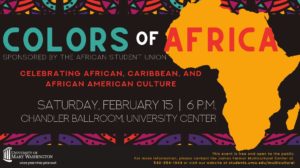
Colors of Africa Saturday, Feb. 15 | 6 p.m. | Chandler Ballroom, University Center
Colors of Africa
Saturday, Feb. 15 | 6 p.m. | Chandler Ballroom, University Center
Sponsored by the African Student Union and the James Farmer Multicultural Center
Colors of Africa seeks to celebrate the culture that Black people create. Whether it is Black people of the African continent, African Americans, or the Caribbean, Blackness is a transnational and multicultural experience and it ought to be celebrated as such.
Sponsored by the African Student Union and the James Farmer Multicultural Center. If you have any questions, contact the James Farmer Multicultural Center at 540-654-1044 or visit students.umw.edu/multicultural